On November 1, 2026, the Claude API lists four generally available current models, from Claude Haiku 5.5 at $0.10 per million input tokens to Claude Fable 5.1 at $10 (Anthropic pricing). All four accept 1 million tokens of context and return up to 128,000 tokens (Anthropic models overview). Between the cheapest and the most expensive of the four, the price per token differs 100 times.
At Oligamy Software we test many LLMs side by side, hosted and local, and build enterprise applications on them, document pipelines among them. This post prices one workload, a 10 page PDF, on every current Claude model and on comparable OpenAI and Google models, using official list prices only. For a local open weight model it gives the break even volume instead of a price, because that cost depends on your hardware, and then shows how we set up an evaluation.
Status on November 1, 2026: every price comes from the vendor pricing page on that day. Google lists a lower price for Gemini 4 Argon until November 30, 2026, and we give both Argon prices.
Key takeaways
- At our stated assumptions, a 10 page PDF costs $0.0097 on Haiku 5.5, $0.19 on Sonnet 5.5, $0.39 on Opus 5.5 and $0.97 on Fable 5.1. The Batch API halves each figure.
- Haiku 5.5 bills five times more per token once a prompt passes 100,000 tokens. At our estimate of 8,000 tokens a page, a 13 page PDF costs $0.0605 against $0.0113 for 12 pages.
- Three Claude models have an OpenAI model at the same base list price. Haiku 5.5 and GPT-6 Luna both cost $0.10 / $0.50 per million tokens, Sonnet 5.5 and GPT-6.1 Sol $2 / $10, Fable 5.1 and GPT-6 Astra $10 / $50. Above 100,000 prompt tokens Haiku 5.5 costs five times as much, while GPT-6 Luna keeps its price up to 272,000.
- On the first party Claude API,
inference_geotakes "global" (any available geography) or "us". EU residency goes through Amazon Bedrock or Google Cloud at a 10% premium, or through a local model. - $1,000 a month buys about 103,000 such documents on Haiku 5.5, or about 5,150 on Sonnet 5.5. A local deployment has to beat that with GPUs, power and engineering time included.
The Claude lineup on November 1, 2026
- Claude Fable 5.1 (
claude-fable-5-1) costs $10 / $50 per million input and output tokens. - Claude Opus 5.5 (
claude-opus-5-5) costs $4 / $20, and Anthropic suggests starting with it for most workloads. - Claude Sonnet 5.5 (
claude-sonnet-5-5) costs $2 / $10. - Claude Haiku 5.5 (
claude-haiku-5-5) costs $0.10 / $0.50 for prompts up to 100,000 tokens and $0.50 / $2.50 above that. Anthropic aims it at classification, extraction and routing.
Cache reads cost 2.5% of the input price on Fable 5.1, 5% on Opus 5.5 and Sonnet 5.5, and 10% on Haiku 5.5.
Two details move a document bill more than the headline price. Anthropic bills thinking tokens as output tokens, and on Opus 5.5 and Fable 5.1 thinking is always on, steered only by the effort setting. Haiku 5.5 is also the only current Claude model priced by prompt length.
What one PDF page costs in tokens
According to the Anthropic PDF support page, each page typically uses 1,500 to 3,000 tokens of text, and each page is also converted into an image and billed as one. The vision docs count one token per 28 by 28 pixel patch, capped at 4,784 tokens per image on Claude 4.7 and later models.
By our reading of the two pages, a typical page sent as a PDF costs at most about 7,800 tokens, 3,000 of text plus up to 4,784 for the page image, and we round that to 8,000. Dense pages can exceed it, and Anthropic does not state the resolution at which it renders a page, so treat 8,000 as an estimate to check with token counting. These are the assumptions behind every figure in this post:
- 10 pages per document, for example a loan file, a claim or a supplier contract.
- 8,000 input tokens per page, so 80,000 for the document.
- 2,000 tokens of instructions and output schema.
- 3,000 output tokens for the extracted JSON and the thinking behind it, the same on every model, although the default effort is
highon Fable 5.1 and Sonnet 5.5 andmediumon Opus 5.5 and Haiku 5.5.
That gives 82,000 input tokens and 3,000 output tokens per document. If you run OCR first and send plain text, a page drops to 1,500 to 3,000 tokens, and at 3,000 tokens a page every cost below falls by about half.
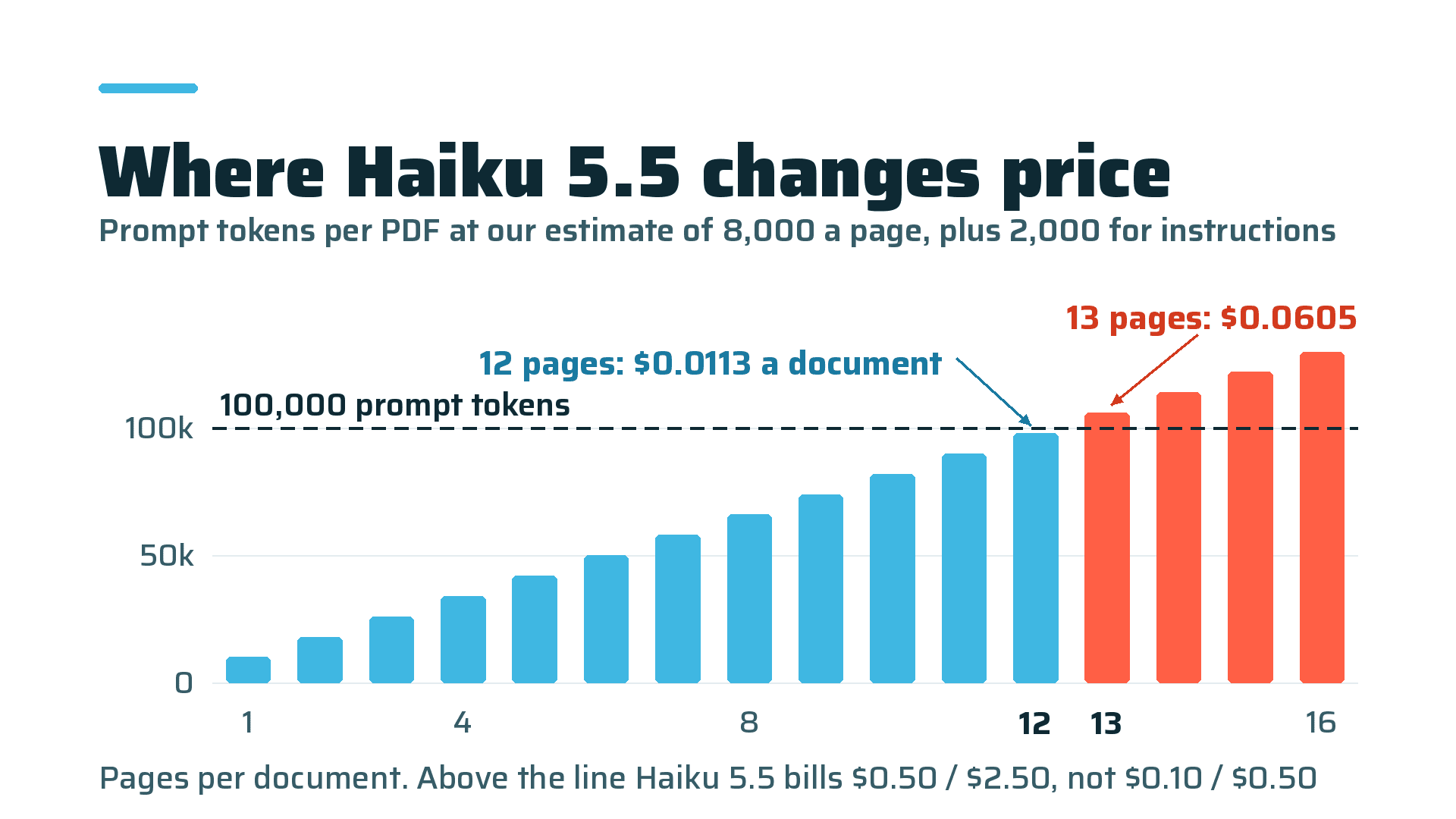
The threshold applies to the whole request, cached tokens included. Above it Haiku 5.5 bills $0.50 for input and $2.50 for output on every token, so the 13th page makes a 12 page document 5.4 times as expensive. Count tokens per request with the token counting endpoint and split long files at section boundaries, though a split cuts context that runs across pages.
Cost per document, step by step
On Sonnet 5.5, 82,000 input tokens at $2 per million cost $0.164, and 3,000 output tokens at $10 per million cost $0.030. The document costs $0.194. The same arithmetic gives $0.0097 on Haiku 5.5, $0.388 on Opus 5.5 and $0.97 on Fable 5.1, or $9.70, $194, $388 and $970 per 1,000 documents from Haiku to Fable.
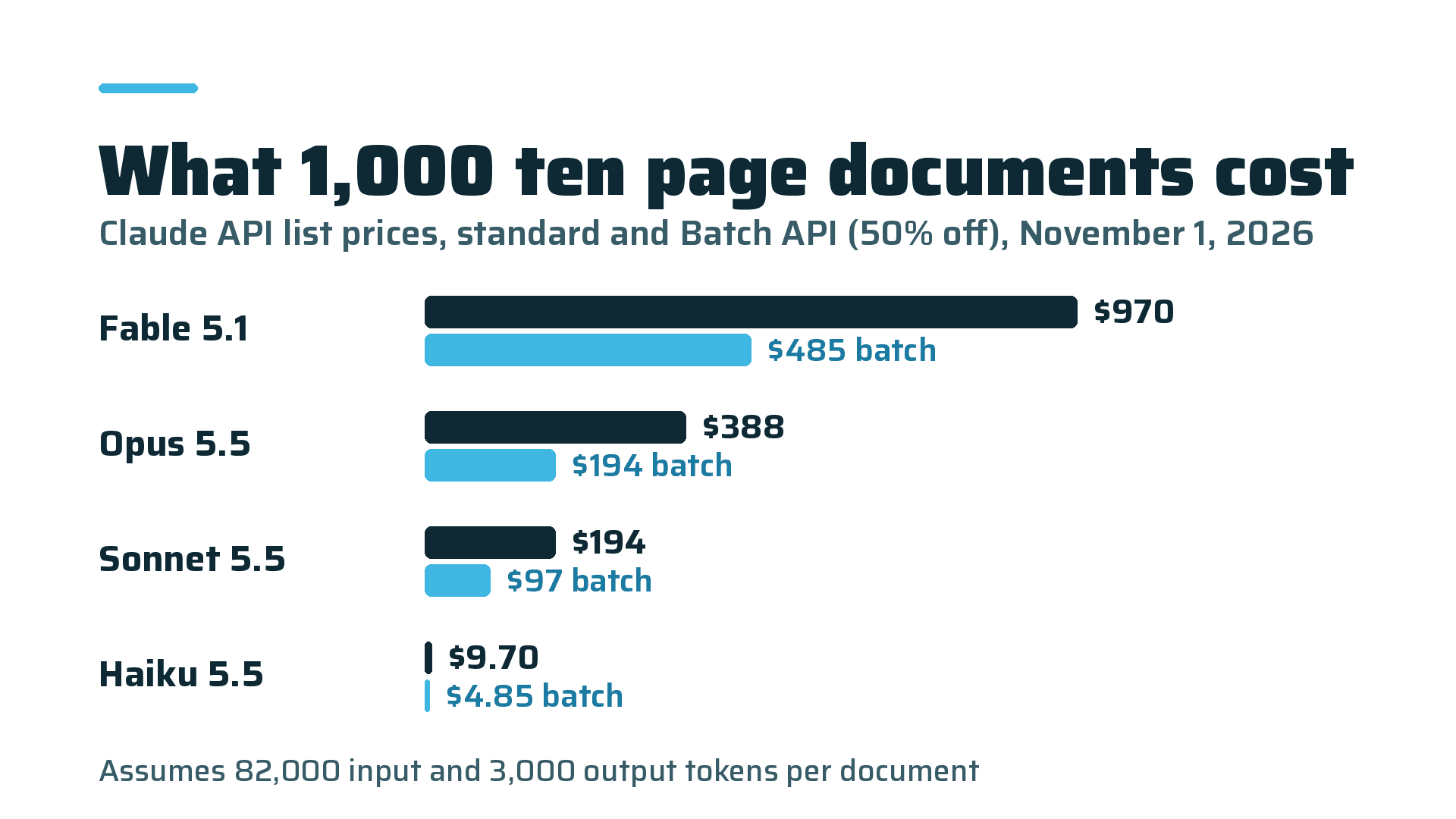
Three modifiers change these figures, and Anthropic stacks them with each other.
- The Batch API takes 50% off input and output and returns results asynchronously, which suits overnight backlogs. It stores requests and results for up to 29 days, is not eligible for zero data retention, and is not available on Amazon Bedrock or on Google Cloud (Google managed).
- US only inference with
inference_geo: "us"multiplies every token category by 1.1. - Prompt caching saves about $0.004 per document on Sonnet 5.5, roughly 2%, because only the 2,000 tokens of instructions repeat. It pays off when the same long document is queried many times.
How the price compares with OpenAI and Google
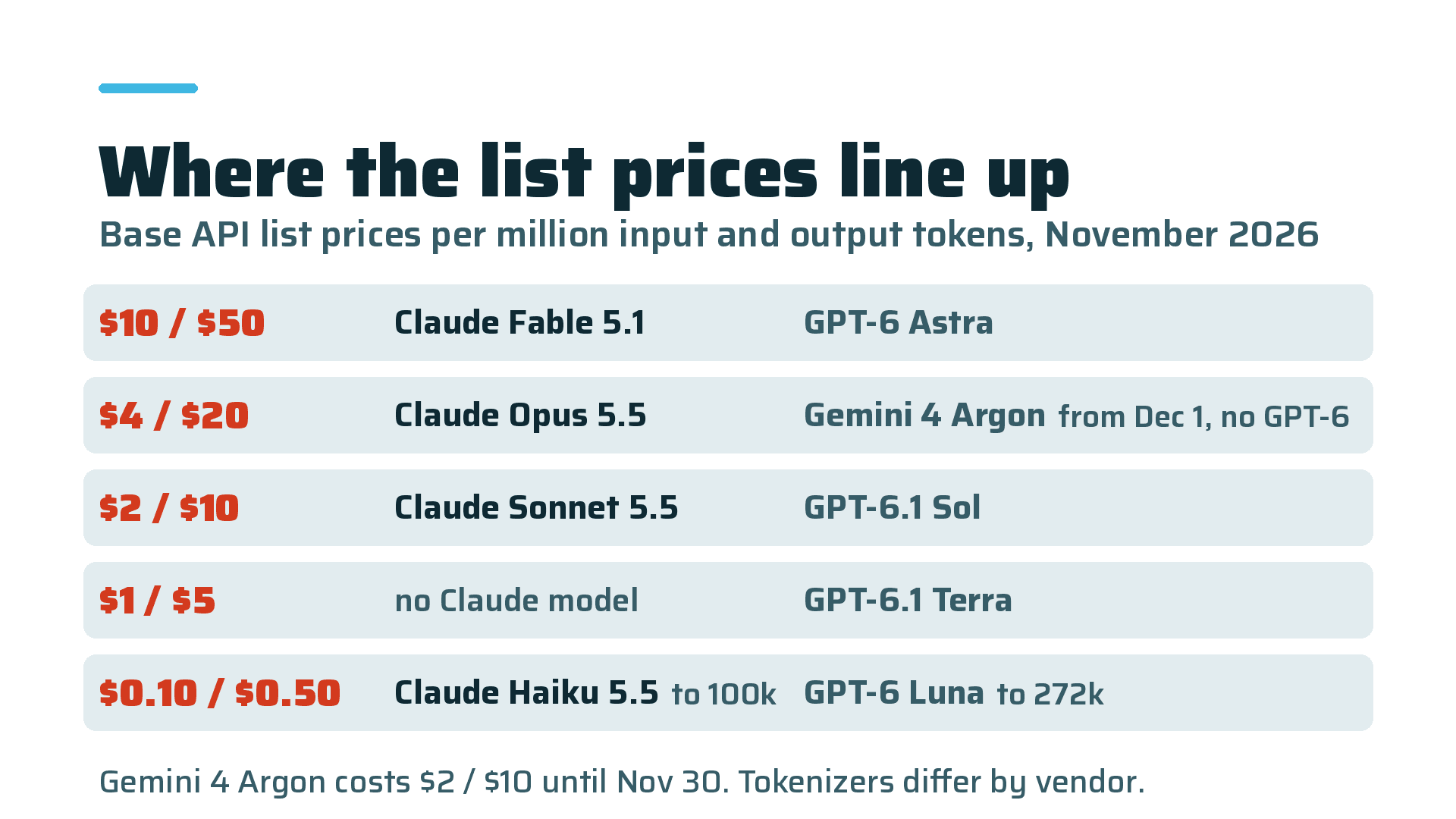
OpenAI lists GPT-6 Astra at $10 / $50, GPT-6.1 Sol at $2 / $10, GPT-6.1 Terra at $1 / $5 and GPT-6 Luna at $0.10 / $0.50, for prompts up to 272,000 tokens (OpenAI pricing). Google lists Gemini 4 Argon at $2 / $10 until November 30, 2026 and $4 / $20 from December 1 (Gemini API pricing).
Three Claude models share a base list price with an OpenAI model, and the rest of the price lists differ. Opus 5.5 has no GPT-6 model at $4 / $20 and meets Gemini 4 Argon only from December 1, GPT-6.1 Terra has no Claude model at its price, and GPT-6 Luna keeps its base price up to 272,000 prompt tokens where Haiku 5.5 changes at 100,000. Cache reads differ too: $0.25 per million on Fable 5.1 against $1.00 on GPT-6 Astra.
In our reading, where two models share a list price, the price per token stops deciding between them. The bill depends on how many tokens each vendor counts for the same page, how many thinking tokens the model spends, and how often it gets a field right. Every vendor uses its own tokenizer, so the same PDF will not come to 82,000 tokens everywhere.
Where local open weight models fit
A local model has no list price. You pay for GPUs, bought or rented, for power, for a serving stack such as vLLM, and for the engineering time to rerun your evaluation whenever the weights change. Hosted vendors publish open weight models too: OpenAI describes gpt-oss-120b as a 117 billion parameter model with 5.1 billion active parameters that fits on a single H100 GPU, under the Apache 2.0 license. It takes text input only, with a 131,072 token context window, so scanned pages need OCR first, and the fair hosted comparison is then the plain text variant at 1,500 to 3,000 tokens a page.
To find the volume at which a local setup beats the hosted bill, divide its full monthly cost by the hosted cost per document. At our assumptions, each $1,000 a month equals about 103,000 documents on Haiku 5.5 (206,000 in batch), 5,150 on Sonnet 5.5 and 2,580 on Opus 5.5. In the plain text variant at 3,000 tokens a page, the same $1,000 covers about 213,000 documents on Haiku 5.5 and 10,600 on Sonnet 5.5.
We think a local deployment pays off on price against Haiku 5.5 only at very high volume. Against Sonnet 5.5 or Opus 5.5 it can pay off at moderate volume, if an open weight model reaches the accuracy you need on your documents. Finding that out takes a labeled sample of your documents, for hosted and local models alike.
In our document classification system, a fine tuned model clears 98.2% of contracts on the first pass and sends the ambiguous 1.8% to a person. In our RAG at scale system, sending only the relevant passages instead of whole documents cut LLM cost by 96%.
How we set up an LLM evaluation for documents
The evaluation measures what a correct document costs on each model, hosted or local.
- One document set for every model. Only the model and its settings change between runs. The set includes scans, rotated pages, stamps, handwriting and tables that run across pages.
- A labeled sample. People enter the expected value for every field. A document with one wrong amount counts as failed.
- Cost per document from the API response. Each response reports input, output and cache tokens, and Claude also reports how many output tokens went to thinking.
- Latency as p50 and p95 per document, measured from your own network at production concurrency.
- Residency and retention per endpoint. We record where inference runs and what the vendor stores. Fable 5.1 requires 30 day retention and is "not available under ZDR unless expressly authorized by Anthropic" (Anthropic data retention).
- Failure modes by type. We log invented values for empty fields, misread tables, values from the wrong page, unit errors, refusals and truncated output.
This function prices a Claude response from the token counts it returns.
# Price one Claude API response from its usage block.
# USD per million tokens: (input, 5 min cache write, cache read, output), list prices on Nov 1, 2026.
PRICES = {
    "claude-fable-5-1":  (10.00, 12.50, 0.25, 50.00),
    "claude-opus-5-5":   (4.00, 5.00, 0.20, 20.00),
    "claude-sonnet-5-5": (2.00, 2.50, 0.10, 10.00),
    "claude-haiku-5-5":  (0.10, 0.125, 0.01, 0.50),   # prompts up to 100,000 tokens
}
HAIKU_OVER_100K = (0.50, 0.625, 0.05, 2.50)            # whole request, cached tokens included

def cost_usd(model: str, usage, batch: bool = False, us_only: bool = False) -> float:
    fresh = usage.input_tokens
    write = usage.cache_creation_input_tokens or 0      # assumes 5 min cache; 1 h writes cost 2x input
    read = usage.cache_read_input_tokens or 0
    inp, w, r, out = PRICES[model]
    if model == "claude-haiku-5-5" and fresh + write + read > 100_000:
        inp, w, r, out = HAIKU_OVER_100K
    usd = (fresh * inp + write * w + read * r + usage.output_tokens * out) / 1_000_000
    return usd * (0.5 if batch else 1.0) * (1.1 if us_only else 1.0)

# usage.output_tokens already includes thinking tokens; log usage.output_tokens_details.thinking_tokens per document as well.
What decides between hosted Claude and a local model
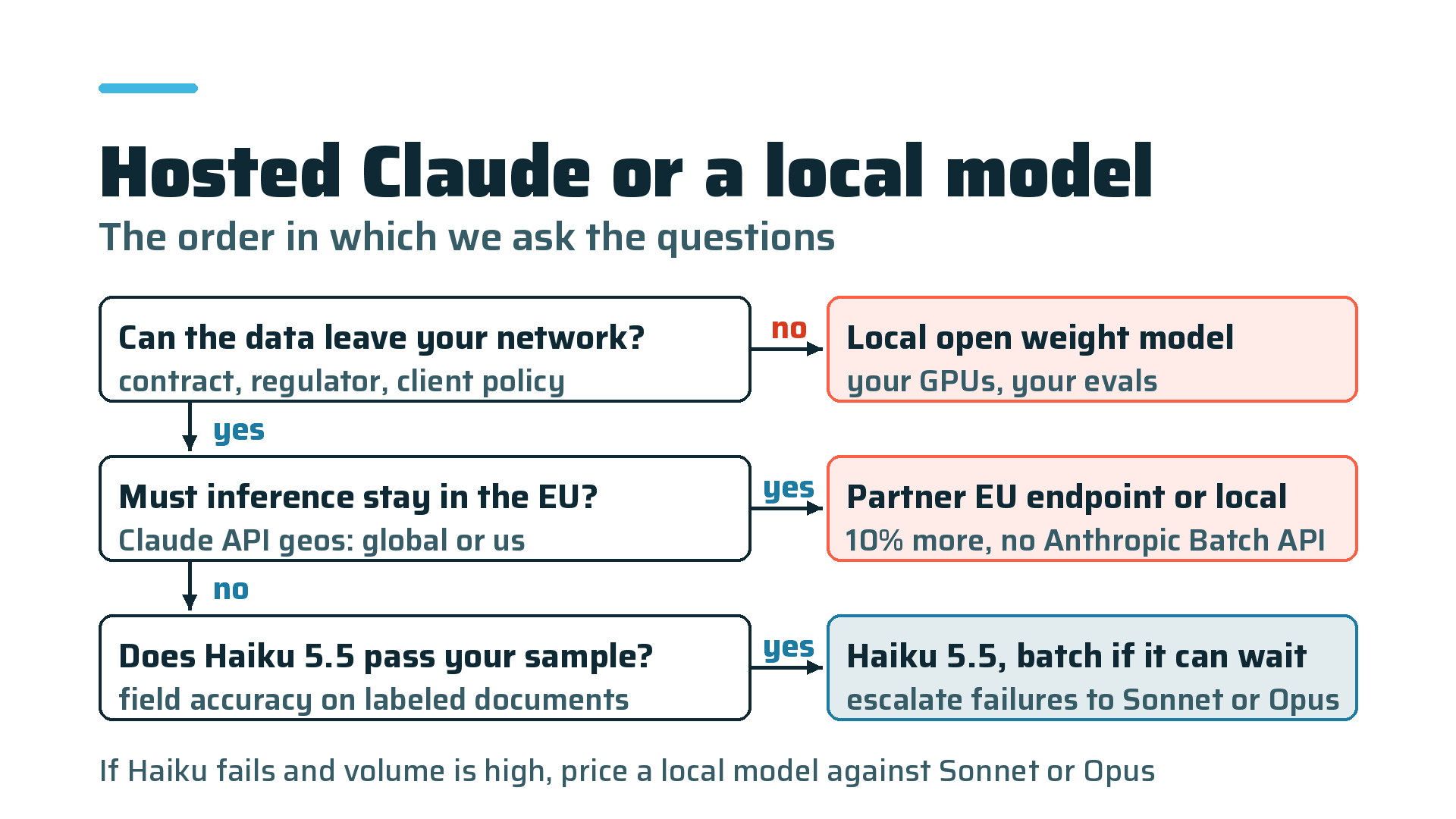
We ask these questions in order.
1. Data that cannot leave the building. If a contract, a regulator or a client policy keeps documents on your hardware, the answer is a local open weight model. A hosted model can still serve the document types cleared to leave.
2. Where inference must run. On the first party Claude API, inference_geo takes "global" (the default) or "us", and "us" is the only workspace geo for data at rest (Anthropic data residency). For EU residency, Claude runs on Amazon Bedrock regional endpoints and EU inference profiles, or on the Google Cloud "eu" multi region endpoint, both 10% above global prices and without the Anthropic Batch API. Bedrock offers Fable 5.1 regionally only in us-east-1 and sets its own access criteria for Opus 5.5, Sonnet 5.5 and Haiku 5.5, so confirm EU access before you plan on it.
3. Volume. At 50,000 documents a month, our 10 page document costs $485 on Haiku 5.5 and $9,700 on Sonnet 5.5, and that is the monthly figure a local setup has to beat.
4. Quality on hard layouts. Run the labeled sample on the cheapest model first and move a document type up only when it fails there. Add the reviewer hours for documents that still need a person to the cost per document.
5. Maintenance. Anthropic retires models on announced dates, and new versions change API behavior: a request that switches thinking off works on Claude Opus 5 and returns a 400 error on Opus 5.5 (migration guide). A local model adds GPU capacity planning, patches for the serving stack and a full evaluation run whenever you swap weights.
6. One gateway in front of every model. An LLM gateway routes each request by document type and sensitivity and logs model, tokens, cost and latency. Moving a document class from Sonnet to Haiku, or to a local model, then becomes a measurable configuration change.
What this calculation cannot tell you
- How many tokens your pages use. Anthropic ties the range of 1,500 to 3,000 text tokens to content density, and a scan without a text layer may yield little extracted text next to its page image, so count 50 real files before you budget.
- How many thinking tokens your runs spend at the effort you choose.
- How many documents a GPU hour handles locally, which only a load test on your hardware shows.
- Prices after the dates we checked. Gemini 4 Argon already has a higher price set for December 1, 2026.
If you are choosing models for a document pipeline, our intelligent document processing team runs this evaluation on your own files. For the wider build, see AI solutions. See also fine tuning vs RAG and custom document AI for fintech and insurance.
Frequently Asked Questions
Model choice measured on your own documents
We run your documents through hosted Claude models and a local open weight model, then report field accuracy, cost per document and latency for each.
Book a free technical validationSources
All pages were accessed on November 1, 2026. Cost per document figures are our own calculation.
- Anthropic, Pricing and Models overview
- Anthropic, PDF support, Vision and Token counting
- Anthropic, Adaptive thinking, Batch processing and Claude Opus 5.5 migration guide
- Anthropic, Data residency and API and data retention
- Anthropic, Claude in Amazon Bedrock and Claude Models on Google Cloud (Google managed)
- OpenAI, API pricing, Models and gpt-oss-120b
- Google, Gemini Developer API pricing
- Anthropic, Claude plans and pricing
- vLLM, documentation