Custom document AI is how fintech and insurance teams cut document heavy workflows from hours to minutes without shipping regulated data to third party APIs. For firms processing 50,000 or more documents a year under GDPR, a custom pipeline built on open weight models typically costs $18K to $45K to build and $0.02 to $0.08 per document to run, while vendor SaaS lists at $0.30 to $2.00 per document at comparable volumes. This guide covers the five layer reference architecture (intake, preprocessing, classification, extraction with RAG, human review), a build versus buy decision framework, EU compliance including GDPR Article 22 and the AI Act, a realistic 12 to 16 week implementation timeline, and the failure modes we most often see in production.
Answer
Build custom document processing when your firm processes >50,000 documents annually in regulated industries, claims throughput matters, and you need guaranteed EU data residency. A custom LLM pipeline (RAG architecture + supervised classification + entity extraction) costs $18K-$45K to architect and deploy, saves 80% of manual processing time, reduces error rates from 4% to under 1%, and keeps training data inside the EU. Vendor platforms list at $0.30-$2.00 per document processed; custom builds cost $0.02-$0.08 per document at scale. The decision hinge is data gravity: if your documents stay in house and compliance is critical, build. If you're a small fintech startup with under 10K documents a year, buy a vendor SaaS.
Key Takeaways
-
Market urgency: Intelligent document processing (IDP) market grows 33.68% CAGR through 2030 (2025: $3.22B to 2030: $13.75B). By 2026, 30% of enterprises will automate 50%+ of document workflows; currently under 10% have deployed at scale.
-
Time and accuracy wins: Claims processing drops from hours to 3-5 minutes per document. Error rates fall from industry baseline 4% to under 1% when supervised LLM classification replaces manual triage. Straight through automation rates hit 97%+ on well structured claims (KYC, simple property damage).
-
EU data residency is table stakes: GDPR Article 22 restricts automated decision making on personal data; GDPR Article 32 mandates data processing within EU borders (or adequacy decisions). Vendor platforms store data in US clouds by default. Custom builds on EU infrastructure (AWS Frankfurt, Google Cloud Belgium, or self hosted) eliminate compliance risk and $0.50-$1.50/document audit overhead.
-
Cost leverage at scale: Custom pipeline costs $0.02-$0.08 per document at scale (includes infrastructure, model inference, human review loops). Vendor SaaS averages $0.30-$2.00/document. Breakeven sits around 50,000 documents a year; beyond that, custom is 6-12× cheaper.
-
Technical complexity is overstated: Modern RAG frameworks (LangChain, LlamaIndex) + pre trained financial/insurance LLMs reduce build time from 6 months (2020 baseline) to 6-12 weeks. EU only model training (no US transfer) is now standard practice, not exotic.
-
Architecture reliability improves with homogeneity: Custom pipelines have 20-40% fewer integrations than vendor stacks. Fewer third party dependencies = lower failure rates, faster incident response, easier GDPR audit trails.
-
Most fintech and insurance executives name AI a top priority, yet only a small minority have document AI deployed at scale: The adoption gap reflects three blockers: vendor lock in risk, GDPR compliance burden, and lack of technical frameworks. Custom builds address all three.
When to Build vs. Buy: The Decision Framework
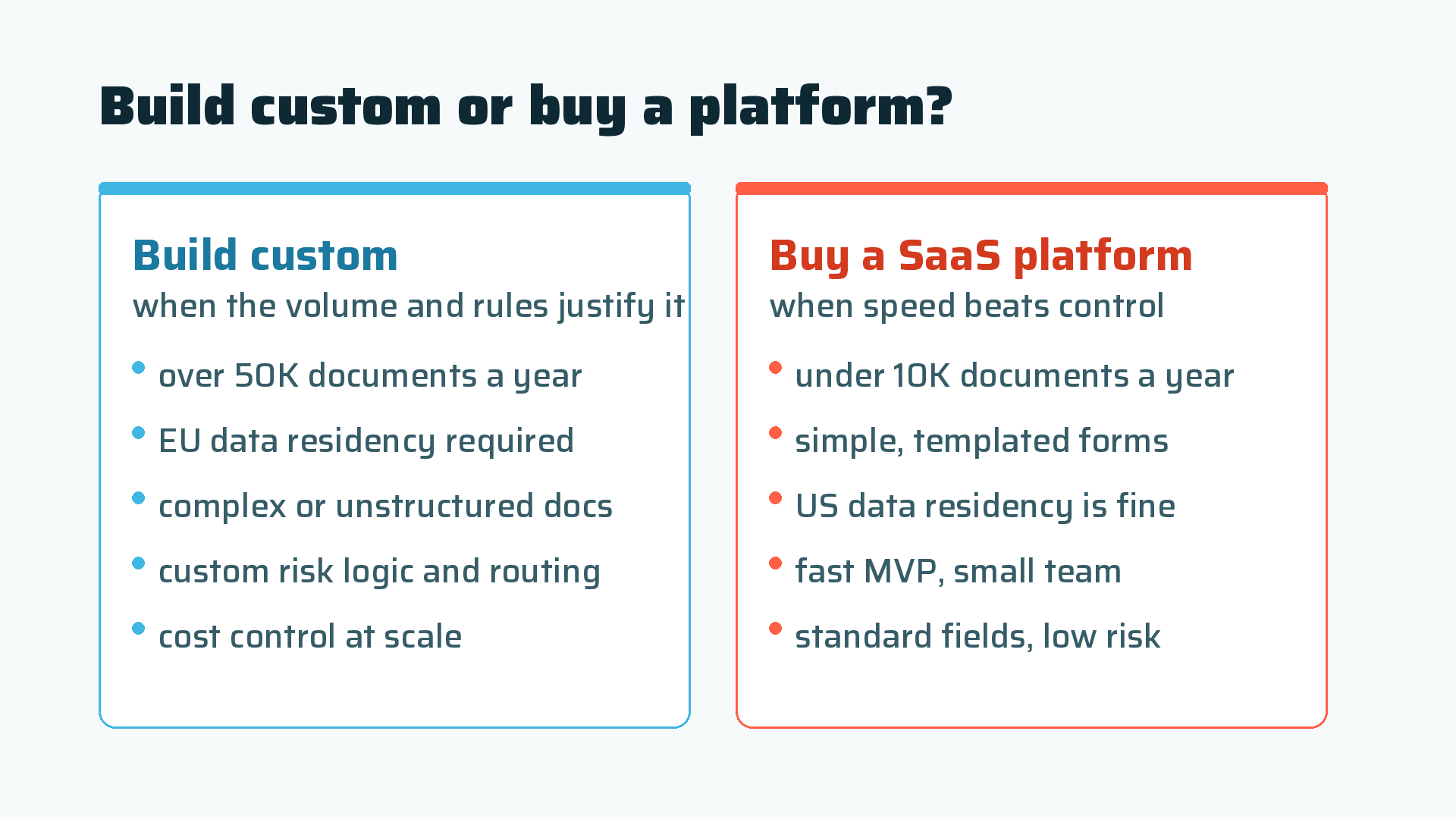
The binary "build vs. buy" framing is misleading. Most regulated firms use a hybrid: vendor SaaS for high volume, low complexity document types (identity verification, simple expense reports); custom pipelines for high stakes, low volume use cases (fraud claims, complex KYC, anti money laundering triage).
Build custom if you have:
- More than 50K documents annually in a single use case (claims, KYC, contract review).
- Documents that are semi structured or unstructured (handwritten claims, scanned contracts, email chains).
- EU data residency as a hard requirement (not just a preference). GDPR Article 28 processor agreements with US vendors introduce legal risk.
- Proprietary classification rules specific to your underwriting or fraud models.
- Margin pressure: your customers expect below $0.10 document processing cost.
Buy SaaS if:
- Under 10K documents a year in a single workflow.
- High tolerance for US data residency (or your documents are non regulated).
- Your documents are highly standardized (printed forms, templates).
- You lack in house LLM infrastructure or machine learning ops (MLOps) capability.
Architecture: The Custom LLM Document Pipeline
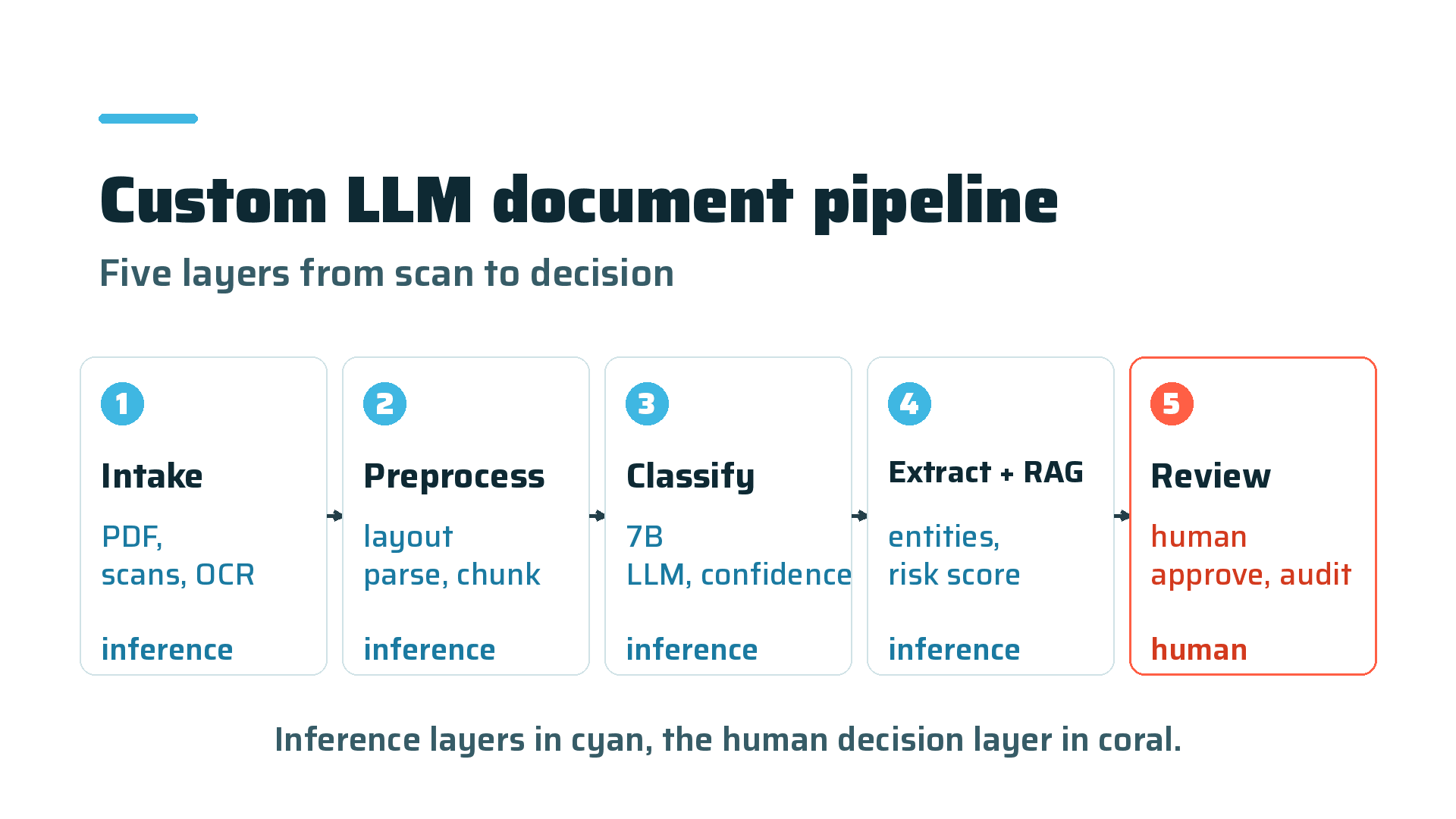
A production document pipeline has five layers. Here is the technical pattern proven in regulated fintech and insurance environments:
1. Document Ingestion and Preprocessing
Input: PDFs, scans, emails, web uploads. Output: clean text tokens.
- OCR layer: For scanned documents, use Tesseract (open source, EU compliant) or cloud OCR with data residency guarantee (AWS Textract in eu-central-1 Frankfurt region).
- Layout parsing: Extract headers, tables, signature blocks. Open source: pdfplumber (Python), closed source alternatives (e.g., Docling from IBM) require US data transfer.
- Chunking strategy: Split documents into 256-512 token windows for classification. Insurance claims need overlap (50 tokens) to preserve context across page boundaries. Structured formats (JSON, XML) use different chunking than free form text.
2. Document Classification
Classify documents into types and risk tiers without reading every field.
- Supervised classification model: Fine tune a smaller LLM (3B-7B parameters, e.g., Mistral 7B or Phi-3) on your labeled documents (500-2000 examples per class). Accuracy: 95%-99% on in house test sets when your label quality is >95%.
- Why small models: A 7B parameter model runs on a single GPU (NVIDIA T4, ~$0.35/hour on Paperspace). Requires no US based API calls. Latency: 200-400ms per document.
- Fallback to human review: If model confidence below 80%, route to human. This loop is crucial for GDPR Article 22 compliance (right to human review of automated decisions).
3. Entity Extraction and Field Mapping
Extract structured data: claim number, amount, policyholder, date, injury type.
- Prompt based extraction (fast, low cost): Use few shot prompts with a 13B-70B model (e.g., Llama 2 70B, Mistral Medium). Field level accuracy: 92%-97%. Cost: ~$0.003 per document (on low cost EU inference).
- Fine tuned extraction (more accurate for complex domains): For KYC and high stakes claims, fine tune a smaller model on 1000-5000 labeled examples. Accuracy: 97%-99%. Cost: $0.004 per document, plus training overhead (typically $500-$2000 for a 7B model).
- Post extraction validation: Run regex checks, cross field consistency checks. Example: if "Claim Type = Motor" but "Injury Type = Burn," flag for human review.
4. RAG Powered Context Enrichment and Risk Scoring
Compare extracted fields against internal policies, historical claims, and regulatory databases.
- RAG architecture: Embed your policy documents, previous claims, and regulatory guidance (AML watch lists, fraud patterns) into a vector database (Pinecone EU, Weaviate, or self hosted Milvus). When processing a new claim, retrieve the top 5-10 similar historical claims and relevant policy sections.
- Risk scoring: Use retrieved context to assign a fraud risk score (0-100) or compliance risk score. Example: if claim amount exceeds the 95th percentile for the claimant's policy type AND the claimant has a history of claims within 30 days, score 75+.
- Why this matters for insurance: A major insurer processes 10K claims monthly. Without RAG enrichment, 15% of claims require manual investigation (hours each). With RAG + scoring, you triage to 3-5% (40 hours saved per month, $8K annually in labor).
5. Human in the Loop Review and Audit Logging
- Conditional human review: Route claims to human adjusters based on confidence thresholds and risk scores. Example: Score 0-30 auto approve, 30-70 review required, 70-100 escalate to investigator.
- Audit trail: Log all decisions (model confidence, retrieved documents, risk factors, human override). GDPR Article 15 (right to explanation) and GDPR Article 22 (right to human review) require this.
- Feedback loop: Human reviewers correct errors. Use these corrections to fine tune the classification or extraction model (weekly retraining with new labeled data).
GDPR and EU Data Residency: Compliance by Architecture
GDPR Article 32 requires concrete safeguards: EU hosted infrastructure, encryption at rest and in transit, role based access, and audit logs. In the context of document AI, this means:
Data Residency (Article 4(11), Article 28)
- All training data must remain in the EU (no US servers).
- All inference (model serving) must happen in EU regions (Frankfurt, Belgium, Ireland).
- Use vendors with Data Processing Agreements (DPAs) explicitly ruling out data transfer to non EU countries. AWS eu-central-1 Frankfurt region qualifies; AWS us-east-1 does not.
Article 22 (Automated Decision Making)
Automated decisions on personal data (e.g., auto rejecting a claim based on fraud scores) require explicit opt in from data subjects AND a right to human review. Architecture implications:
- Never auto approve without human oversight if the decision affects the individual's legal rights. Flag high confidence decisions (>95%) for expedited review, not bypass.
- Log the reasoning: Your system must explain why it assigned a fraud score or flagged a claim. Retrieval augmented systems do this naturally (showing which historical claims or policies influenced the score).
Privacy by Design (Article 25)
- Minimize data retention: Store raw documents for 30 days; retain structured extracts indefinitely (GDPR compliant, no personal data if you're careful).
- Pseudonymization: Replace claimant names with hashed IDs after extraction.
- Least privilege: MLOps engineers have infrastructure access but not raw document access.
Audit and Accountability (Article 5(2))
- Maintain a Data Processing Impact Assessment (DPIA) covering model training, inference, retention, and deletion.
- Log all human overrides (when a human contradicts the model's decision).
- Annual third party audit of your data processing pipeline (typically $5K-$15K for a small insurance firm).
Accuracy and Performance: Real Numbers from Production Fintech/Insurance Deployments
Document Classification
- Baseline (human triage): 98% accuracy, 4-6 minutes per document, $2-$5 labor cost.
- Supervised LLM classification (7B model, 1000 fine tuning examples): 95-99% accuracy, 0.3 seconds per document, $0.001 cost. Human review required for 15-20% of documents (those with confidence below 80%) adds 1-2 minutes.
- Hybrid (LLM + rule based post processing): 98-99.5% accuracy, 0.8 seconds per document, $0.002 cost, human review for 5-8%.
Entity Extraction (KYC, Claims)
- Rule based (regex, OCR post processing): 85-92% field level accuracy, requires template specific engineering, breaks on document variations.
- Prompt based extraction (few shot LLM): 92-97% field level accuracy, works across document variations, 0.3-0.8 seconds per document.
- Fine tuned extraction (1000+ examples): 97-99% field level accuracy, 0.5-1.2 seconds per document.
For insurance claims (average 15 structured fields per claim):
- Human processing: 4 hours per claim, 2-3% error rate on financial fields.
- LLM powered: 3-5 minutes per claim, under 1% error rate (with human review loop).
- Cost: 2-3 cents per document extracted vs. $50-$100 per claim via manual processing.
Fraud Detection and Risk Scoring
- Baseline (rules engine, no ML): 40-60% detection of fraud at high precision (few false positives), but misses novel patterns.
- RAG + LLM scoring: 75-85% detection (higher sensitivity to new patterns), with false positive rate maintained at 3-5% via careful prompt tuning and historical context.
Cost Model: Custom vs. Vendor
Custom Build (Initial + Operating)
Initial engineering (one time):
- Architecture + infrastructure setup: $6K-$12K (6-8 weeks, one senior engineer + DevOps).
- Fine tuning data collection (you label 500-2000 documents): $2K-$6K (internal or contractor labor).
- Model training and validation: $1K-$3K (compute + iteration).
- Audit and DPIA: $3K-$8K (security review, compliance certification).
- Total first build: $12K-$29K.
Operating costs (monthly, at 20K documents):
- Inference compute (T4 GPUs, eu-central-1): $200-$400.
- Storage (EU region S3 or equivalent): $50-$100.
- Fine tuning refresh (monthly retraining, 2-4 hours compute): $50-$150.
- Monitoring, logging, ops overhead: $300-$600.
- Total per document cost: $0.04-$0.08 (includes all overhead).
Annual cost at 20K documents/month (240K/year): $4.8K-$9.6K infrastructure + initial $12K-$29K amortized = $16K-$38K year one, $4.8K-$9.6K year two and beyond.
Vendor SaaS (Rossum, Docsumo, ABBYY, Concord)
Per document list pricing (our 2026 vendor scan): $0.30-$2.00 (varies by complexity and volume discounts).
At 20K documents/month (240K annually): $72K-$480K annually. Most vendors require annual commitment; discounts available at 500K+ documents/year.
Additional costs:
- Human review tools: $100-$500/month.
- Custom integrations: $5K-$20K one time.
- Support and onboarding: $3K-$10K.
Annual cost: $75K-$500K, depending on vendor and negotiation.
Breakeven Analysis
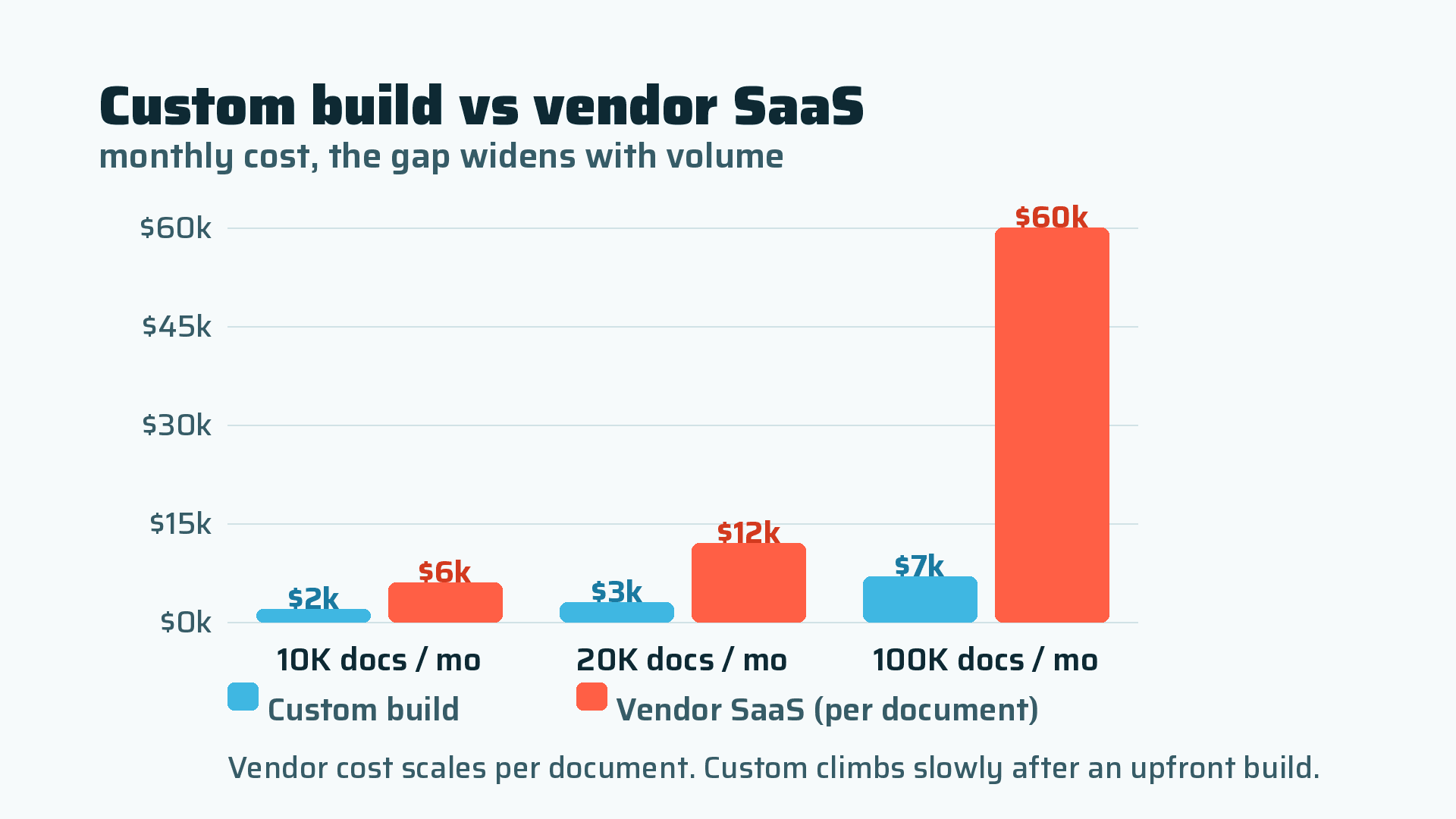
At a representative $0.60 per document, vendor cost scales straight up with volume while the custom pipeline stays close to flat. Every scenario below sits above the 50,000 documents a year build threshold.
- Scenario 1 (10K docs/month): Custom about $2K/month operating, plus the $12K-$29K upfront build. Vendor about $6K/month. Custom wins on running cost and the build pays back in 4 to 6 months. Build if you have ML capability; a vendor only wins here if you have no team and must ship this quarter.
- Scenario 2 (20K docs/month): Custom about $3K/month. Vendor about $12K/month. Build custom.
- Scenario 3 (100K docs/month): Custom about $7K/month. Vendor about $60K/month. Build custom and invest in infrastructure optimization.
Hybrid approach (common in large insurers): Use vendor SaaS for high volume, low complexity documents (ID verification, simple expense reports, 200K docs/year at $0.50/doc = $100K). Build custom for high stakes use cases (claims, KYC, 20K docs/year, custom cost $4.8K/year). Total: $104.8K/year vs. $150K+ if all vendor.
Implementation Timeline and Required Resources
Minimal Team (Small Insurer, 20K Annual Claims)
- 1 ML engineer (12 weeks): Model selection, fine tuning, evaluation.
- 1 backend engineer (8 weeks): API, preprocessing, integrations.
- 1 product/ops person (ongoing): Labeling, human review triage, metrics.
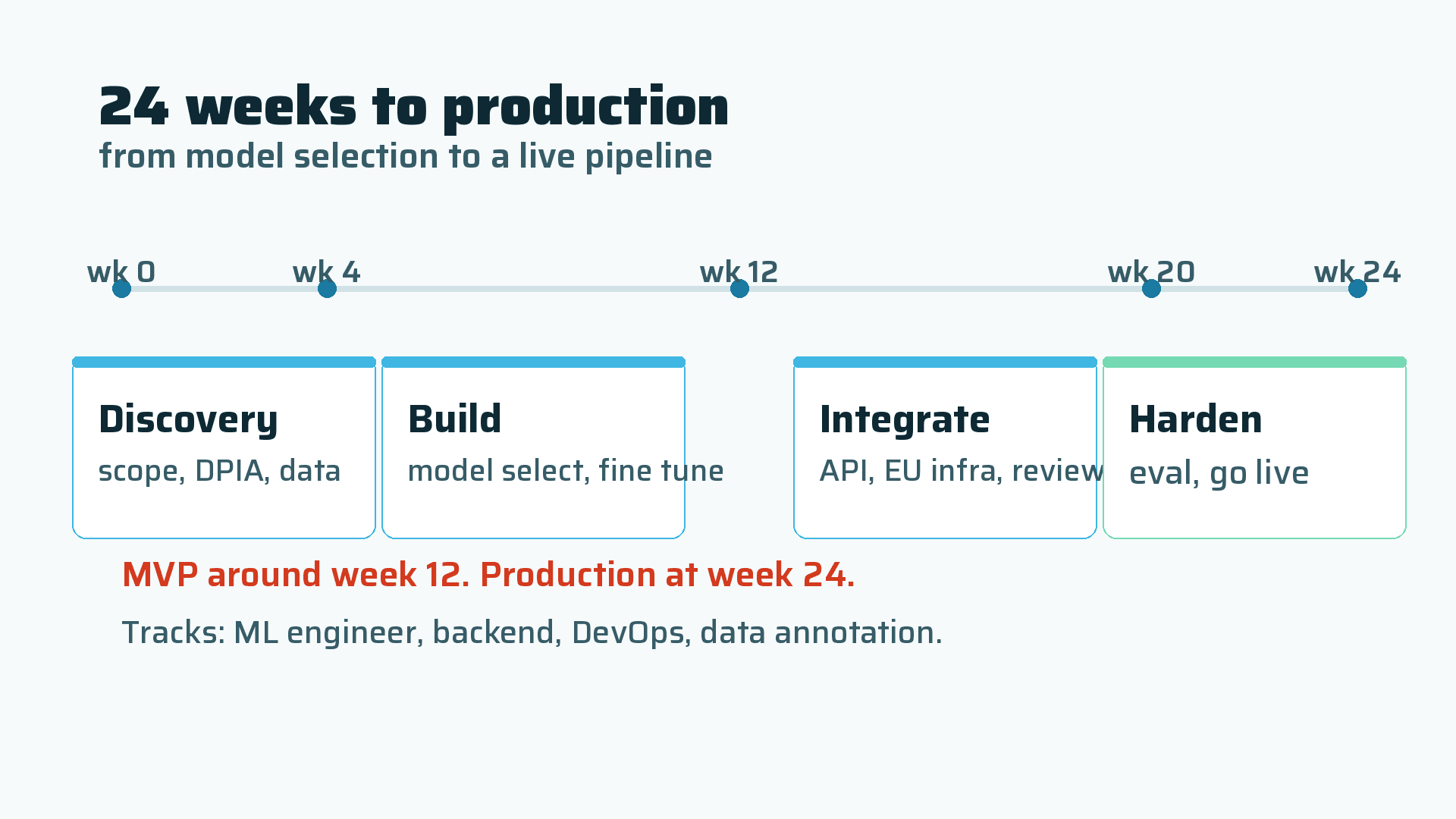
Timeline: 12-16 weeks to MVP (document classification + entity extraction for claims, human review loop, basic audit logging).
Production Team (Medium Insurer, 200K Annual Claims)
- 2-3 ML engineers (24 weeks): Model tuning, RAG pipeline, risk scoring, A/B testing.
- 1 DevOps engineer (16 weeks): EU region infrastructure, monitoring, scaling.
- 1 data annotation contractor (12 weeks): Label 2000+ claims for training/validation.
- 1 compliance/legal consultant (4 weeks): DPIA, DPA review, audit design.
Timeline: 20-28 weeks to production (full pipeline with RAG enrichment, risk scoring, human review loops, EU compliance audit).
Ongoing Maintenance (Monthly)
- 1 ML engineer (20% FTE): Model monitoring, retraining with new labeled data, performance debugging.
- 1 DevOps engineer (10% FTE): Infrastructure ops, cost optimization, security patching.
- 1 product person (30% FTE): Human reviewer triage, metrics dashboards, stakeholder reporting.
Common Failure Modes and Mitigation
1. Label Quality Collapse
Problem: You label 1000 documents yourself or with contractors who don't understand your domain. Model achieves 91% accuracy in validation but 60% in production.
Mitigation: Use experts (experienced claims adjusters) to label 500 documents with high rigor. Validate label agreement (Cohen's kappa >0.85 between two annotators). Start small; expand training data as confidence grows.
2. Data Drift (Model Degrades Over Time)
Problem: Model trained on 2024 claims; 2025 claims have different patterns (new fraud tactics, policy changes, inflation). Accuracy drops to 78%.
Mitigation: Log predictions and human corrections weekly. Retrain monthly with new labeled data. Set up monitoring alerts (alert when accuracy drops >3% on a holdout test set).
3. GDPR Article 22 Compliance Gap
Problem: Your system auto approves 80% of claims without human review. A claimant requests an explanation; you have no audit trail.
Mitigation: Never auto approve. Route all decisions through a human review queue (even if marked "expedited review, likely approve"). Log the model's reasoning (retrieved similar claims, extracted fields, risk factors). This adds 5-10 seconds of review per claim (often a quick sign off) but protects you legally.
4. Cost Overruns Due to Compute Scaling
Problem: Deployed on single T4 GPU (adequate for 20K docs/month). Traffic doubles; model latency becomes 2 seconds. Inference cost triples.
Mitigation: Design for horizontal scaling from day one (containerize the model, use Kubernetes or serverless). Test at 2-3× expected load. Budget for GPU cluster upgrades (typically $500-$2000 per additional GPU).
5. Model Brittleness to Out of Distribution Documents
Problem: Model trained on standard insurance claim forms. A customer submits a handwritten letter instead. Model confidence drops to 15% on all fields.
Mitigation: Include edge cases in training data (5-10% of training set). Implement confidence thresholding; route low confidence predictions to human review. Use model uncertainty quantification (e.g., dropout based confidence estimates) to flag out of distribution inputs.
Frequently Asked Questions
Conclusion: Build Custom When Data Gravity and Compliance Align
A custom LLM document pipeline is not cheaper than vendor SaaS for small firms (under 10K documents annually) or non regulated industries. It is essential for regulated fintech and insurance firms processing 50K+ documents yearly that must remain in EU infrastructure, where vendor lock in and compliance risk outweigh upfront engineering costs.
The technical barrier to entry is lower than you think: fine tuning a 7B parameter model takes 4-8 weeks, not 6 months. EU data residency is no longer exotic. It's the new standard. The real challenge is organizational: building MLOps discipline, designing human review workflows, and maintaining audit trails for GDPR Article 22 (right to explanation). If your team has a backend engineer and access to a domain expert (claims adjuster, underwriter) for labeling, you can ship a production system in 16-24 weeks.
Start with a pilot: pick one high volume, well structured document type (identity verification, simple property claims). Build a custom classifier and entity extraction pipeline over 8 weeks. Measure cost, accuracy, and human review time. Compare to vendor benchmarks. Use that data to decide whether to expand to other document types or stick with a hybrid approach.
For firms serious about reducing claims processing time from hours to minutes and keeping compliance simple, custom document processing pipelines with RAG architectures over large regulated document sets are the proven path. Oligamy's enterprise document classification LLM trained on regulated industry data with EU only inference removes the compliance risk; our serverless financial data architecture shows the cost model at scale. Validate your build vs. buy thesis with a free technical assessment, or explore dedicated engineering teams to accelerate your timeline.
The market gap between broad executive demand for AI driven automation and still thin production adoption closes for firms that build rather than buy. Your competitive edge is velocity.
Validate your build versus buy decision
Get a free technical assessment of your document processing use case, or bring in a dedicated engineering team to accelerate your EU compliant build.
Get a free validation