Most teams frame this as a fight. It is not. Fine tuning changes how a model behaves. RAG changes what it knows.
Picking the wrong one for your problem wastes a quarter and a budget, so the real question is which lever your use case actually needs.
This is a decision framework for engineering leaders, built from shipping both in production. It covers what each approach does, what each costs in 2026, the five questions that decide it, and the hybrid pattern that most serious systems converge on.
Key Takeaways
- Fine tuning teaches behavior: tone, output format, domain reasoning, and style. RAG supplies knowledge: current, factual, attributable information retrieved at query time. They solve different problems.
- RAG is the 2026 default. Most enterprises go RAG first for dynamic knowledge and reserve fine tuning for specific behavior, because RAG is more secure, more scalable, and cheaper to keep current.
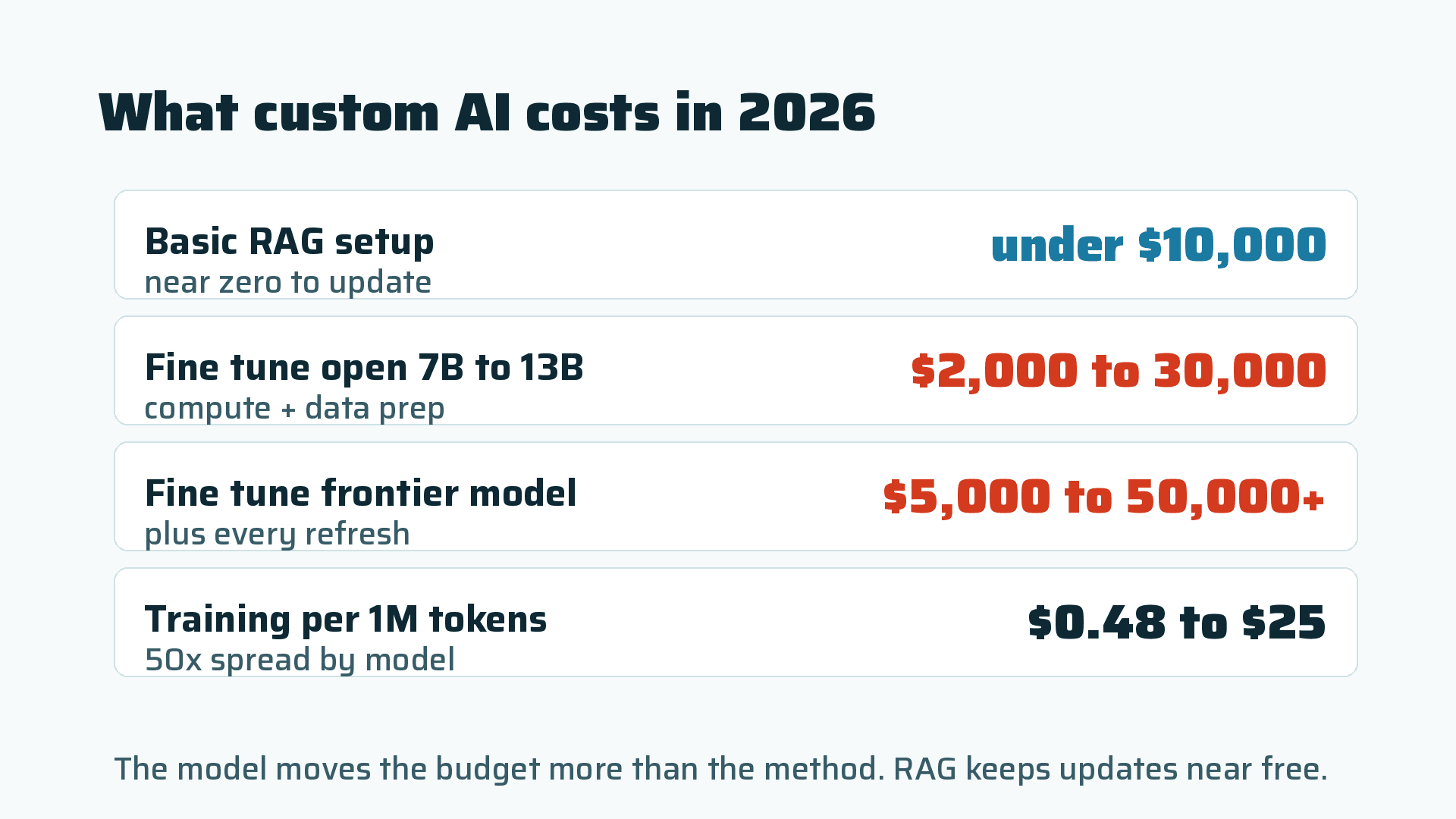
- The cost gap is smaller than CTOs assume. A basic RAG setup runs under $10,000, and fine tuning a 7B to 13B open model costs roughly $2,000 to $30,000, not the $100,000 many expect.
- Training price varies 50x by model: from about $0.48 per million tokens for an open 7B model to roughly $25 per million for a frontier model. Model choice moves the budget more than the method.
- RAG wins on freshness and governance because sensitive data stays in a controlled database. Fine tuning wins on efficiency at scale and on latency, since it skips the retrieval step.
- Most production stacks need both, not one. RAG for knowledge, fine tuning for format and reasoning, long context for single document tasks.
What Each One Actually Does
The confusion starts because both produce a smarter assistant. The mechanism is completely different.
RAG changes what the model knows. At query time it retrieves relevant fragments from your data, inserts them into the prompt, and the model answers grounded in those facts. Update a document and the answer updates instantly, with no retraining. The model weights never change, so your data stays in your database.
Fine tuning changes how the model behaves. You continue training the model on examples until it internalizes a tone, an output structure, or a way of reasoning about your domain. The knowledge becomes part of the weights. That makes it fast at inference and consistent in style, but stale the moment your facts change, and expensive to update.
The one line test: if you need the model to know something current and citable, that is RAG. If you need it to act a certain way every time, that is fine tuning.
The Cost Reality in 2026
The biggest myth is that custom models cost six figures. They can, but most do not.
A basic RAG setup runs under $10,000 to stand up, then a predictable monthly run cost dominated by retrieval and generation tokens. Fine tuning a 7B to 13B open model costs roughly $2,000 to $30,000 in compute and data preparation. Fine tuning a larger proprietary model climbs from $5,000 to $50,000 and up.
The variable that moves the budget most is the model, not the method. Training ranges from about $0.48 per million tokens for an open 7B model to roughly $25 per million for a frontier model, a 50x spread. The hidden cost of fine tuning is not the training run. It is the data preparation and the fact that every knowledge change means another run. RAG moves that recurring cost to near zero, because updating knowledge means updating a document.
The Decision: Five Questions
Skip the rate card and answer these. They settle most cases in minutes.
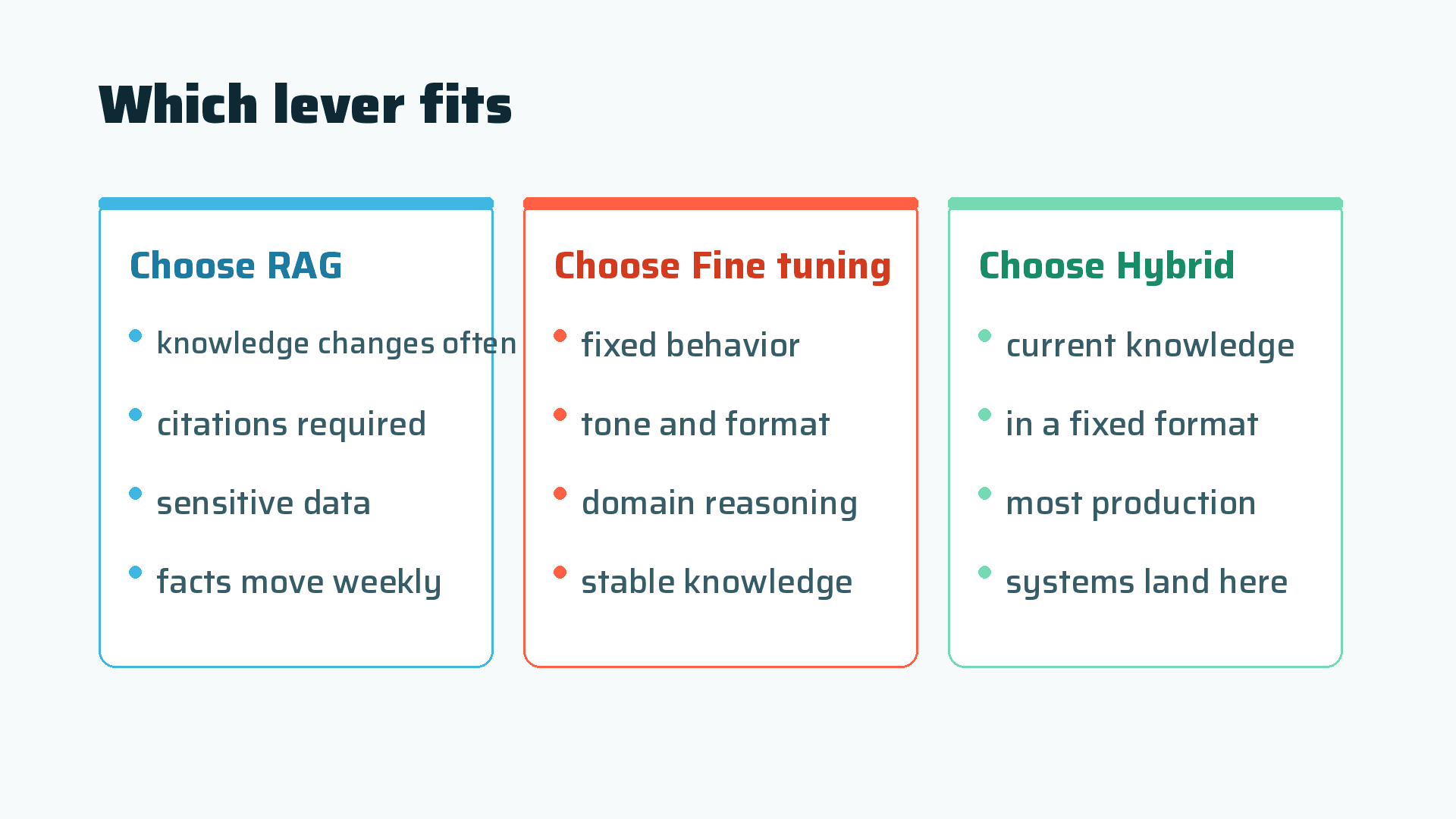
- Does your knowledge change often? Weekly or faster points to RAG. Stable and rarely updated allows fine tuning.
- Do you need citations and source attribution? If an answer must trace to a document, RAG. Fine tuned knowledge cannot cite a source.
- Are you changing knowledge or behavior? New facts is RAG. New tone, format, or reasoning style is fine tuning.
- How sensitive is the data? If it cannot leave your control, RAG keeps it in your database. Fine tuning bakes it into weights you then have to govern.
- Is inference latency or cost critical at scale? A fine tuned model skips retrieval, so at very high volume it can be faster and cheaper per call once the upfront cost is paid.
Why Most Enterprises Go RAG First
In 2026 the default is RAG, and the reasons are practical rather than fashionable.
Security and governance. With RAG, sensitive data stays in a controlled database and never enters model weights. You can revoke a document, audit which fragments produced an answer, and keep records inside your compliance boundary. Fine tuning absorbs the data into weights, which is far harder to govern or unwind.
Freshness. Knowledge that changes weekly is a liability for a fine tuned model and a non issue for RAG. Update the source and the next answer reflects it, with no retraining cycle.
Cost of change. RAG front loads almost nothing and keeps updates near free. Fine tuning front loads the data work and charges again every time the facts move. For most knowledge work, RAG is more secure, scalable, and cost efficient, which is why it anchors the majority of enterprise deployments.
When Fine Tuning Earns Its Cost
Fine tuning is not a fallback. For the right problem it is the only clean answer.
Reach for it when you need to change behavior rather than knowledge: a consistent brand voice, a strict output schema the model must follow every time, or domain reasoning that general models handle poorly. It also pays off when knowledge is stable, when you want the model to internalize specialized terminology, and when latency or per call cost at very high volume justifies the upfront investment, because a fine tuned model skips the retrieval step entirely.
A concrete pattern from our own systems: we fine tune a model to emit structured JSON that matches a client internal template exactly, then let RAG supply the facts that fill it. The behavior is fixed by fine tuning, the knowledge stays fresh through retrieval.
The Hybrid Pattern Most Systems Reach
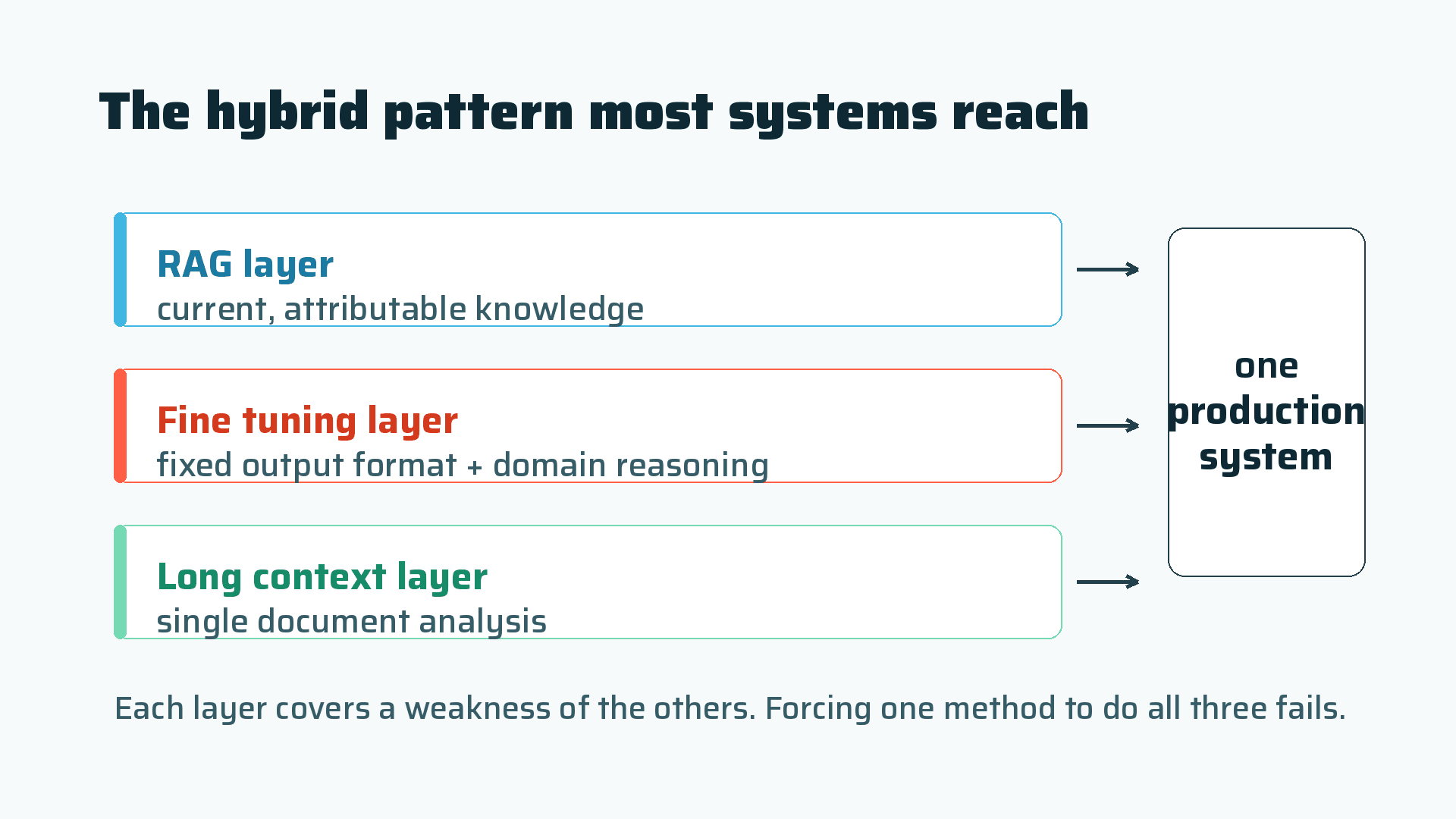
The mature answer is rarely one or the other. Most production stacks need both, layered by what each does best.
A common production shape: RAG handles the knowledge base so answers stay current and attributable, fine tuning handles output format and domain reasoning so every answer arrives in the right shape, and long context handles single document tasks where a user uploads one file to analyze in full. Each layer covers a weakness of the others. The mistake is forcing one method to do all three jobs, which is how teams end up with a system that is either stale, inconsistent, or expensive.
How to Choose for Your Stack
The right architecture follows your data, your update frequency, and your governance constraints, not a default preference. We have shipped RAG, fine tuning, and hybrid systems in fintech, legal, and compliance heavy environments, and the assessment usually takes a short scoping session rather than a long project.
Our AI engineering team maps your requirements to RAG, fine tuning, or a hybrid, and our dedicated team model carries the build and iteration once the direction is set.
Frequently Asked Questions
Choosing between fine tuning and RAG?
We map your data, update frequency, and governance constraints to the right architecture, usually in one scoping session.
Book a free technical validationFor the production engineering behind retrieval at scale, see our enterprise document classification case study. To map fine tuning, RAG, or a hybrid to your use case, book a free technical validation.