Buy if your bottleneck is writing the same answers again. Build if your bottleneck is deciding whether to answer at all.
RFP platforms like Responsive, Loopio and AutoRFP are built mainly for the first problem. They hold a content library, match incoming questions to past answers, and draft a first pass response. That is worth paying for when you receive dozens of questionnaires a month and the same questions keep coming back.
Some platforms now reach into screening as well. Responsive sells Requirements Analysis, which summarizes an RFP, extracts requirements into tables and matches them against keyword dictionaries to support the go or no go call. The hard part is still reading a 90 page tender and working out, before anyone writes a word, whether the scope is something you can deliver, at what risk, and what the client forgot to specify.
That second job is a document extraction and classification problem measured against your own service catalog. No vendor ships your catalog. This article is the architecture we specify when a company decides the qualification step is the one worth automating, including the parts that break.
Key takeaways
- Two different problems. Response generation is a content library problem. Screening and qualification is an extraction and scoring problem. Most teams buy a tool for the first and stay stuck on the second.
- The screening bottleneck is real and measurable. In an engineering firm we scoped this for, a competent estimator spent two to eight hours per inquiry just deciding whether to bid. A well built pipeline targets under thirty minutes, with the final call left to a person.
- Never let a model assert a requirement it cannot quote. Every extracted requirement carries a verbatim span and a location in the source document. Anything without one gets rejected, not shown. This converts hallucination from a probability into a validation rule.
- The gap report is the feature platforms rarely build around. What the tender does not say matters more than what it says. Listing the missing information is the fastest way for the system to earn trust.
- Confidential tenders do not force a cloud decision. Classification and redaction can run locally while only sanitized text reaches a hosted model, which keeps most of the quality and removes most of the exposure.
What RFP screening automation actually is
RFP screening automation reads an incoming tender or request for proposal, extracts every requirement as a structured record, scores each requirement against what your company can deliver, and produces a bid or no bid recommendation with the evidence attached.
It is the step before response generation. Response tools assume the decision to bid has already been made. Screening starts earlier, with a mixed bundle of PDFs, spreadsheets and email threads that nobody has read yet.
The distinction matters commercially. Response automation saves proposal writers time. Screening automation stops the company spending three days on a tender it was never going to win, which is a much larger number in most engineering businesses.
Build or buy: the decision at a glance
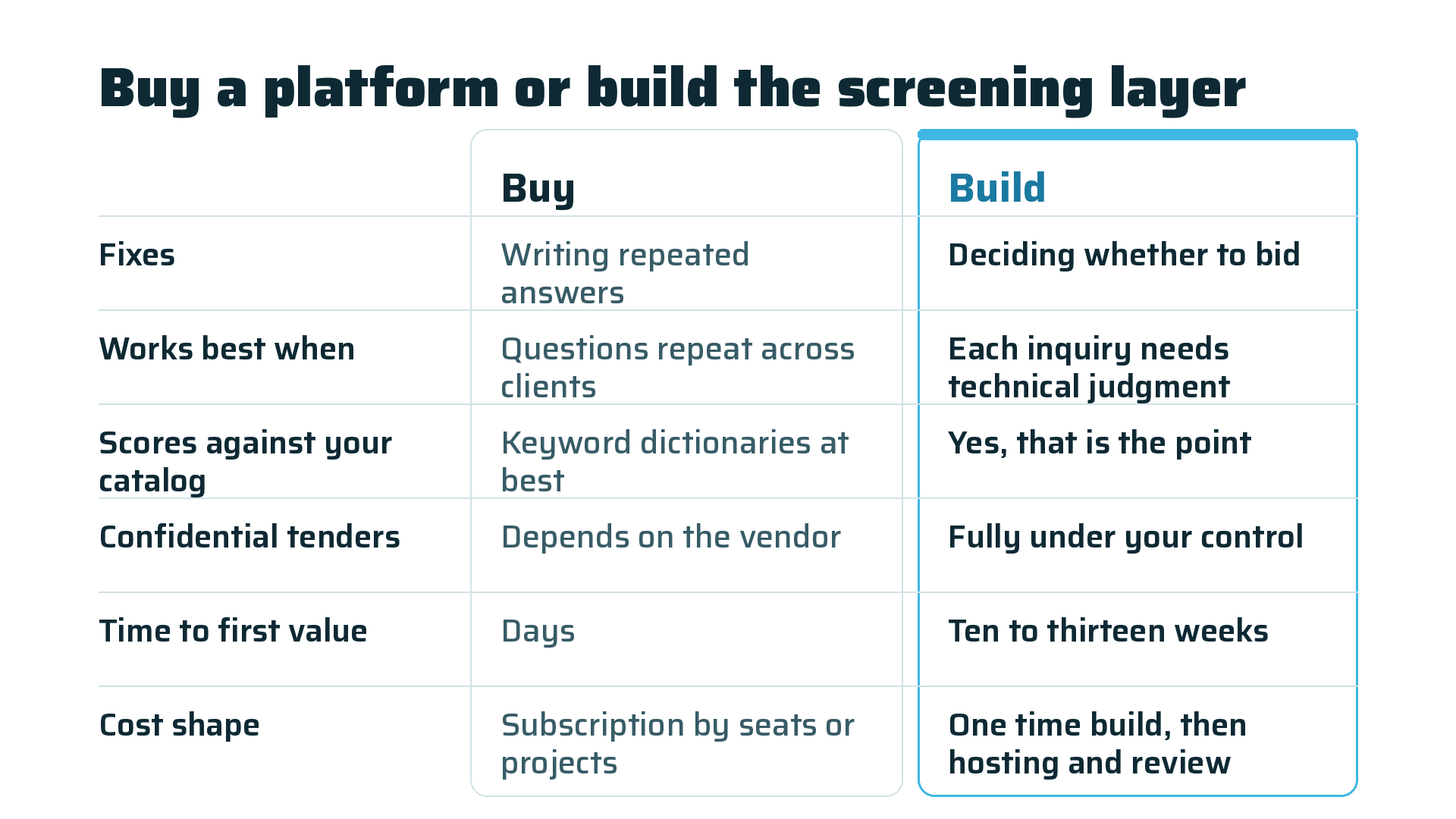
As a rule of thumb, if you answer more than roughly twenty questionnaires a month and the questions repeat, buy a platform and stop reading. If you receive fewer, longer, more technical inquiries where each one needs an engineer to judge feasibility, a platform will not touch your real cost. Build the screening layer and skip the platform.
There is a third path that suits more companies than either camp admits. Buy the response tool for the writing, build the screening layer in front of it, and pass the qualified inquiries through. The two systems do not compete for the same minutes.
The reference architecture
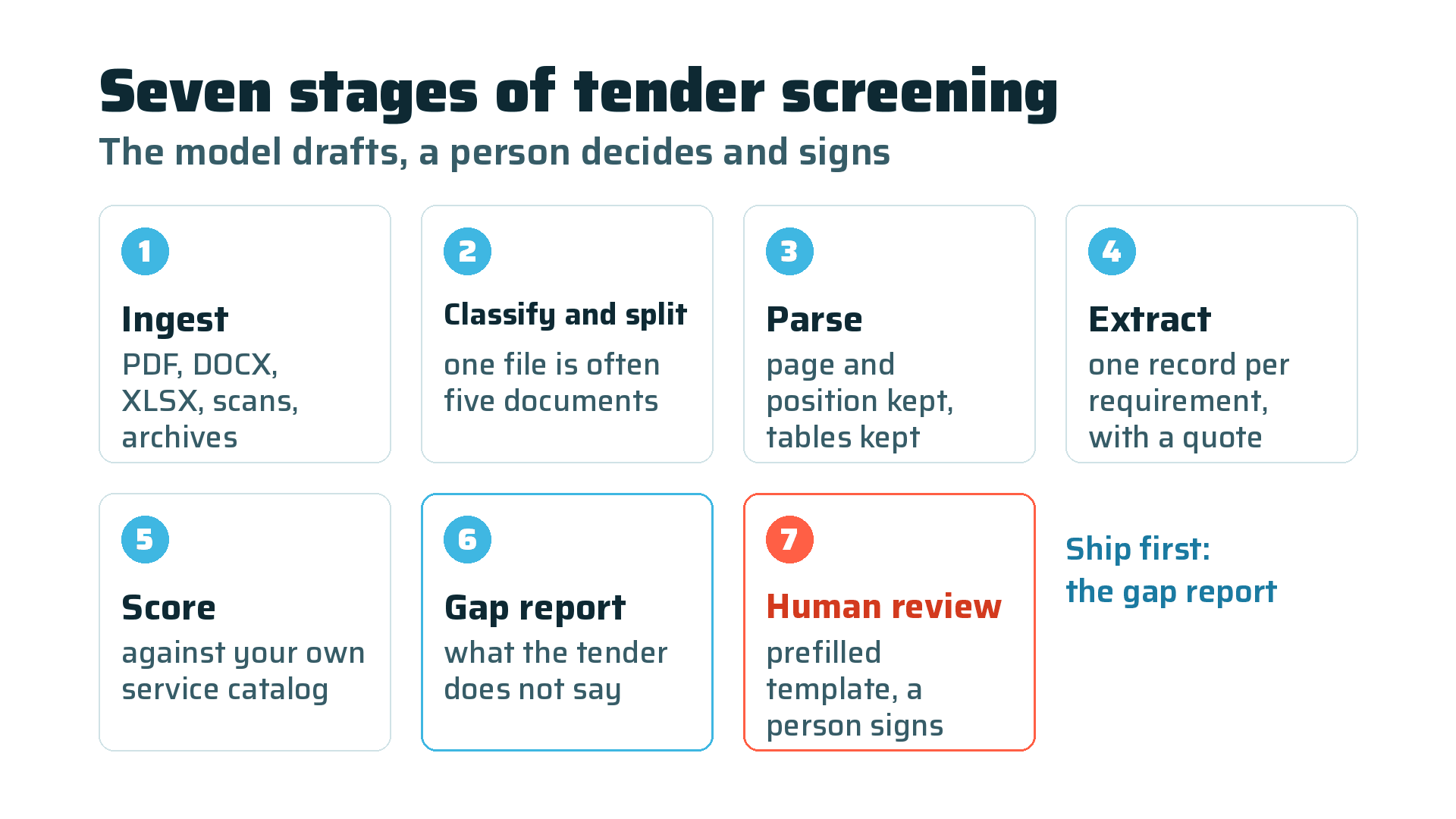
Seven stages. Each one has a failure mode that costs more than the stage itself.
1. Ingest. Inquiries arrive as email attachments, procurement portal downloads, shared drive links and occasionally paper. The ingest layer normalizes PDF, DOCX, XLSX, images and archives into a single document set with a stable identifier per file.
What breaks: the specification arrives as a photograph of a printed page inside a ZIP inside an email. If ingest cannot deal with that, everything downstream reports a clean run on an incomplete input, which is worse than failing.
2. Classify and split. A single PDF in a tender bundle is routinely five documents: a cover letter, a technical specification, a bill of quantities, a draft contract and an annex. Classification runs before extraction, and multi document files get split at the boundaries.
What breaks: treating the bundle as one document. Contract clauses leak into technical requirements, and the scoring stage then measures your capability against payment terms.
3. Parse with provenance. Every chunk of text keeps its document identifier, page number and position. Tables are preserved as tables rather than flattened into prose, because in tenders the requirements usually live in the tables.
What breaks: naive chunking on character count. A requirements table split across two chunks loses the row to column relationship, and the extractor starts pairing the wrong values with the wrong requirements.
4. Extract requirements into a schema. The model returns structured records against a fixed schema rather than free text. One record per requirement, each carrying the verbatim source sentence, its location, a normalized category, and a confidence value. Schema constrained decoding is what makes this reliable enough to build on. See the JSON Schema specification for the constraint layer itself.
What breaks: free text output. A model asked to summarize requirements will produce a plausible list that contains items nobody wrote. The fix is mechanical, not statistical, and it is described in the next section.
5. Score against the service catalog. Each extracted requirement is matched to an entry in your own catalog of capabilities, with a verdict per requirement: covered, partially covered, or not covered. The aggregate becomes a scope match figure, and any single disqualifying item overrides the aggregate.
What breaks: reporting one overall percentage. A tender that is 88% covered but requires a certification you do not hold is a no bid, and an average hides exactly that.
6. Produce the gap report. The system lists what the inquiry does not specify: missing tolerances, absent volumes, undefined delivery terms, unstated standards. These become the questions your team sends back to the client.
What breaks: nothing, which is why this stage is the one to ship first. It is the fastest way to convince a skeptical estimator that the system read the document properly.
7. Prefill and hand to a human. The output populates your existing proposal template and exports in the format your team already uses. A person reviews, edits and signs. The role of the estimator moves from authoring to reviewing, and the system never sends anything on its own.
What breaks: automating the send. The moment a pipeline can commit the company to a scope without a human, its error budget drops to zero and nobody will trust it.
The data contract is the architecture
Everything above holds together because of one structure. This is the record every requirement produces:
{
  "requirement_id": "REQ-014",
  "source": { "document_id": "spec-annex-2", "page": 17, "block": 4 },
  "verbatim": "All welded joints shall be inspected in accordance with EN ISO 17637.",
  "category": "quality_assurance",
  "catalog_match": { "item": "visual weld inspection", "verdict": "covered" },
  "confidence": 0.91,
  "needs_clarification": false
}
Two fields carry the entire trust model. verbatim means a human can check any claim against the source in seconds. confidence combined with a threshold decides what reaches a person instead of a report. Everything else is bookkeeping.
Why every requirement needs a quote
The single most useful rule we apply to this class of system: if the extracted verbatim string cannot be found in the source document by exact match, the record is discarded before anyone sees it.
The check is a validation step in code, run after generation, and it removes an entire category of failure. The model is free to be creative and the pipeline simply refuses the output.
Retrieval grounded generation reduces the rate of invented content, as the original retrieval augmented generation paper and the IBM summary of the pattern both describe, but reduction is not elimination. Verification against the source is what closes the gap.
The same principle carries through our other document work. We wrote about keeping retrieval honest at volume in RAG at scale, and about the regulated version of the problem in custom document AI for fintech and insurance.
Confidential tenders: on premises, cloud, or neither
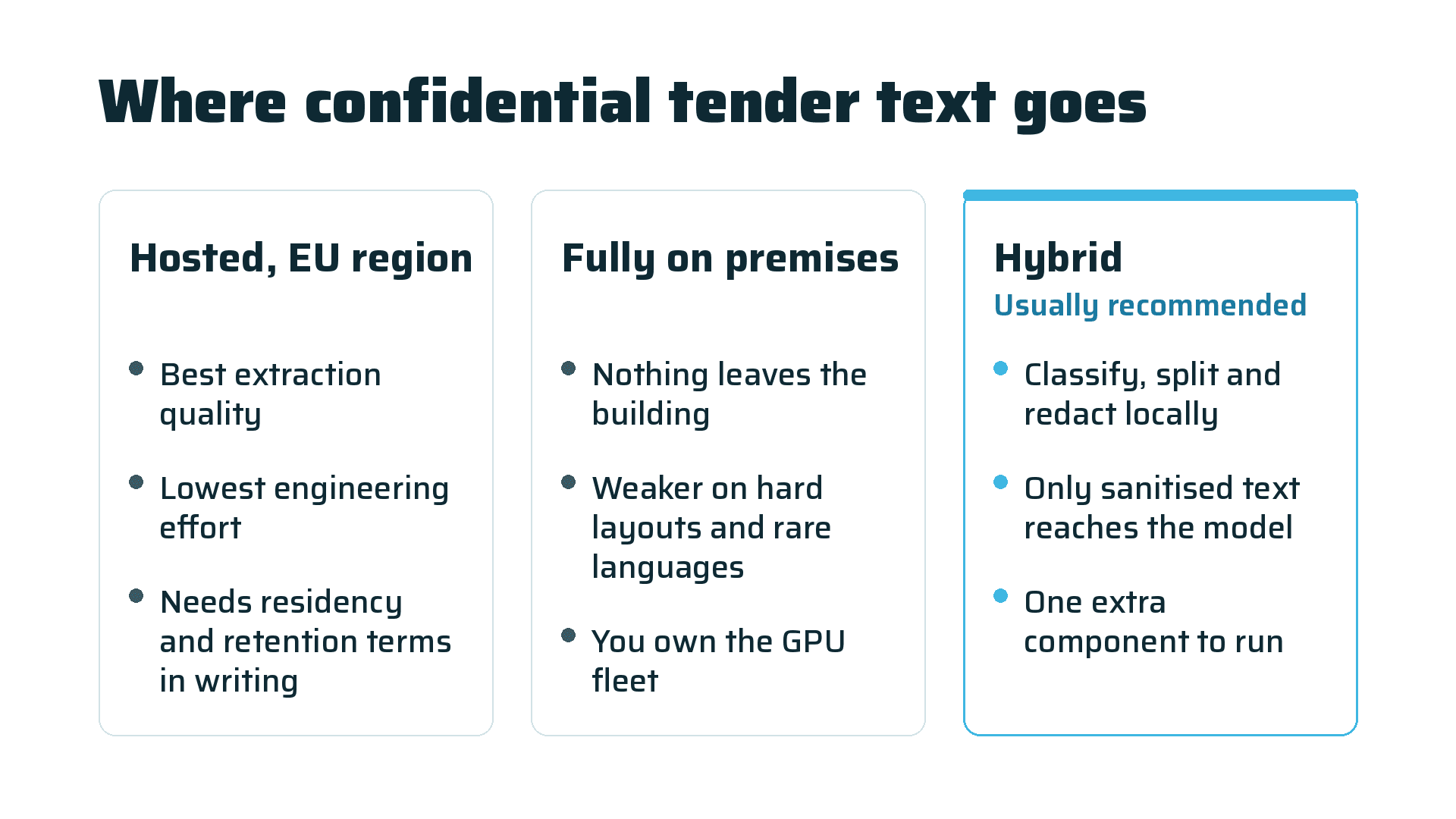
Tender documents are frequently under a non disclosure agreement, and procurement teams are right to ask where the text goes. There are three workable answers.
Hosted model in a controlled region. An enterprise deployment in an EU region with no training on your data and a signed processing agreement. Best extraction quality, lowest engineering effort, and the option most legal teams accept once the data residency and retention terms are in writing.
Fully on premises. Open weight models on your own hardware. Nothing leaves the building, and the tradeoff is honest: quality on difficult layouts and rare languages drops, and you now own a GPU fleet and its upgrade path. Pair it with a local layout model rather than expecting a general model to read complex tables.
Hybrid, which is what we usually recommend. Classification, splitting and redaction run locally. Only sanitized text, stripped of client names, prices and personal data, reaches the hosted model. You keep most of the extraction quality and remove most of the exposure, at the cost of one extra component to maintain.
Decide this before the architecture, not after. Retrofitting on premises inference into a pipeline designed around a hosted API is a rewrite, not a configuration change.
What accuracy to expect, and how to measure it
Do not accept a single accuracy number, and do not publish one either. Measure at field level, per document class, with precision and recall reported separately, because in screening a missed requirement and an invented one carry very different costs.
For calibration, on a narrow and well defined document classification task we have run in production, the pipeline reached 98.2% accuracy with 1.8% of documents automatically flagged for human review, which is written up in our enterprise document classification case study. Requirement extraction from varied tenders is a harder problem than classification, and anyone quoting you the same figure for it is guessing. Expect lower, design the review path accordingly, and measure on your own corpus. Public document understanding benchmarks such as DocVQA are useful for method comparison and useless as a promise about your documents.
Four metrics worth tracking from day one:
- Time per inquiry, measured before and after, on the same class of tender.
- Precision and recall per requirement field, on a labeled sample refreshed quarterly.
- Share of requirements auto approved, meaning above threshold and never touched by a human.
- Agreement with a human panel on the bid or no bid call, which is the metric the business actually cares about.
Timeline, cost shape, and three recommendations
A first production version takes ten to thirteen weeks: roughly two weeks of discovery and labeling on your real documents, four to six weeks of pipeline work, two to three weeks of integration with the systems you already run, and two weeks of hardening. The two labeling weeks are the ones people try to cut, and they decide whether anything else works.
The cost shape differs from a platform in a way worth stating plainly. A platform is a recurring subscription, priced by seats or by project volume, that never ends and never becomes an asset. A pipeline is a larger one time build plus inference and review costs that scale with volume.
Entry plans cost roughly $10,000 a year. Responsive lists its Emerging Edition from $10,000, and AutoRFP charges $899 a month, billed yearly, for 24 projects. At that price a platform is usually cheaper on paper for a team with low inquiry volume. It is also usually solving the other problem.
Three things we recommend, based on specifying this pipeline and similar document systems:
Ship the gap report before the draft generator. It is simpler, it is impossible to fake, and it converts the skeptics on the estimating team into the people who ask when the rest is coming.
Build per document class, not a general parser. A pipeline that handles your three most common tender formats properly beats one that handles everything badly, and you will discover the three formats during labeling.
Set the confidence threshold high at launch and lower it with evidence. A system that sends too much to review looks slow. A system that auto approves a wrong requirement in month one never gets a second chance.
Frequently Asked Questions
Where to take this next
If you receive technical tenders and the qualification step is eating your engineers, start with a measurement before any tool selection. Take twenty recent inquiries, record how long qualification took, and count how many were declined after significant work. That number is the business case.
We build these pipelines as part of our intelligent document processing work, and the modeling side sits under AI solutions. If you want the measurement done on your own documents before committing to anything, that is what our document audit is for.
Measure your tender qualification time first
Take twenty recent inquiries and we measure, on your own documents, how long qualification takes and what a screening pipeline would change.
Start with a document audit