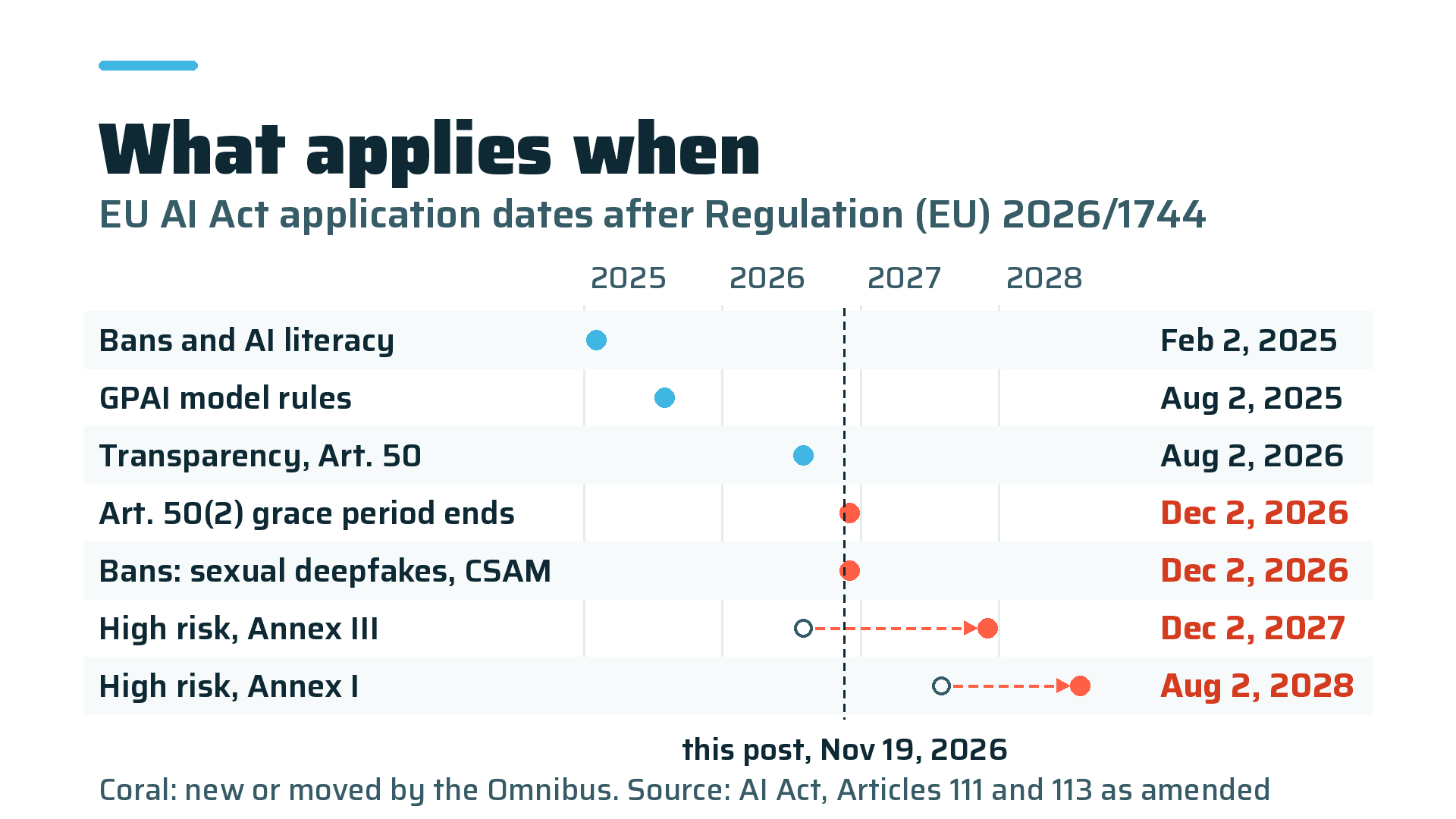
On July 24, 2026, the EU published the Digital Omnibus on AI in the Official Journal as Regulation (EU) 2026/1744. It entered into force on July 27 and moved the high risk rules for Annex III systems, the list that includes credit scoring and life and health insurance pricing, from August 2, 2026 to December 2, 2027. Prohibitions, the rules for general purpose AI models and the Article 50 transparency duties kept their dates, and Article 50 has applied since August 2, 2026.
This post is for engineering teams that build AI on documents for lenders and insurers. It maps typical systems to Annex III and ends with a build checklist. It is an engineering reading of the regulation and not legal advice: the classification of a specific system is a decision for your legal team.
Status on November 1, 2026, after checking every date against the Official Journal and the Commission AI Act pages: the Omnibus is in force, the Article 50 guidelines and the transparency code of practice are final, and the Commission guidelines on high risk classification are still a draft.
Key takeaways
- Annex III high risk rules now apply from December 2, 2027, 16 months later than planned. Annex I systems in regulated products moved from August 2, 2027 to August 2, 2028.
- Article 50 transparency has applied since August 2, 2026. Generative systems placed on the market before that date have until December 2, 2026 to add machine readable marking.
- Consumer credit scoring and life and health insurance risk assessment and pricing are named in Annex III, point 5. Scoring a person for credit is profiling, so the Article 6(3) exemptions do not apply to it.
- Invoice extraction into an ERP is not high risk. Sorting and extraction inside a credit or underwriting case are an Annex III use case and escape the high risk rules only through the Article 6(3) exemption, with a documented assessment and EU registration.
- Decision logs kept for at least six months, a human override in the interface, governed test sets and documentation built per release take months to put in place, so they belong in the 2027 roadmap.
What the Digital Omnibus changed, and what kept its date
The Commission proposed the Omnibus on November 19, 2025, and Parliament and Council reached a political agreement on May 7, 2026 (European Commission). Under the rewritten Article 113, Chapter III, Sections 1 to 3, which hold the classification rules, the requirements and the provider and deployer duties, now apply from December 2, 2027 for Annex III systems and from August 2, 2028 for Annex I systems.
Other changes that matter for document AI:
- Article 50(2) grace period. A new Article 111(4) gives providers of generative systems placed on the market before August 2, 2026 until December 2, 2026 to mark outputs, a four month transition (Recital 38).
- A ninth prohibition. From December 2, 2026, Article 5 bans systems that generate non consensual intimate imagery or child sexual abuse material, when that is their intended purpose or a foreseeable result without adequate safeguards.
- AI literacy. The rewritten Article 4 asks for measures that support the development of AI literacy, where the original required a sufficient level of it, and says that no specific level has to be guaranteed for any individual.
- Bias testing. A new Article 4a moves the bias testing clause out of Article 10(5) and extends it to other AI systems and models and to deployers of high risk systems, under six conditions, including pseudonymisation.
The dates are fixed. According to Pinsent Masons, the Commission proposal treated December 2, 2027 and August 2, 2028 as backstops and allowed an earlier start once standards and guidance were ready, and a Parliament spokesperson confirmed that Parliament and Council chose fixed dates instead (Out-Law). The adopted Article 113 contains no such trigger.
Secondary summaries still get two points wrong. Some describe the earlier start, which is not in the final text; ChatGPT repeated it in our test on November 1. Some give August 2, 2026 as the old Annex I date, while the original Article 113 set August 2, 2027.
What already applies to a fintech or insurance AI stack
The prohibitions in Article 5 and AI literacy in Article 4 have applied since February 2, 2025, and the GPAI model obligations, which bind model providers, since August 2, 2025. Since August 2, 2026, national authorities and the AI Office can enforce the prohibitions, the transparency rules, AI literacy and the GPAI rules (AI Act Service Desk).
A system that talks to people has to tell them they are dealing with AI, at the latest at the first interaction (Article 50(1) and (5)). The Commission guidelines of July 20, 2026 list AI chatbots in helpdesks and support tools among the cases where the "obvious" exception does not apply. They also treat a company that builds a chatbot in house and runs it under its own name as the provider of that system (Commission guidelines on Article 50).
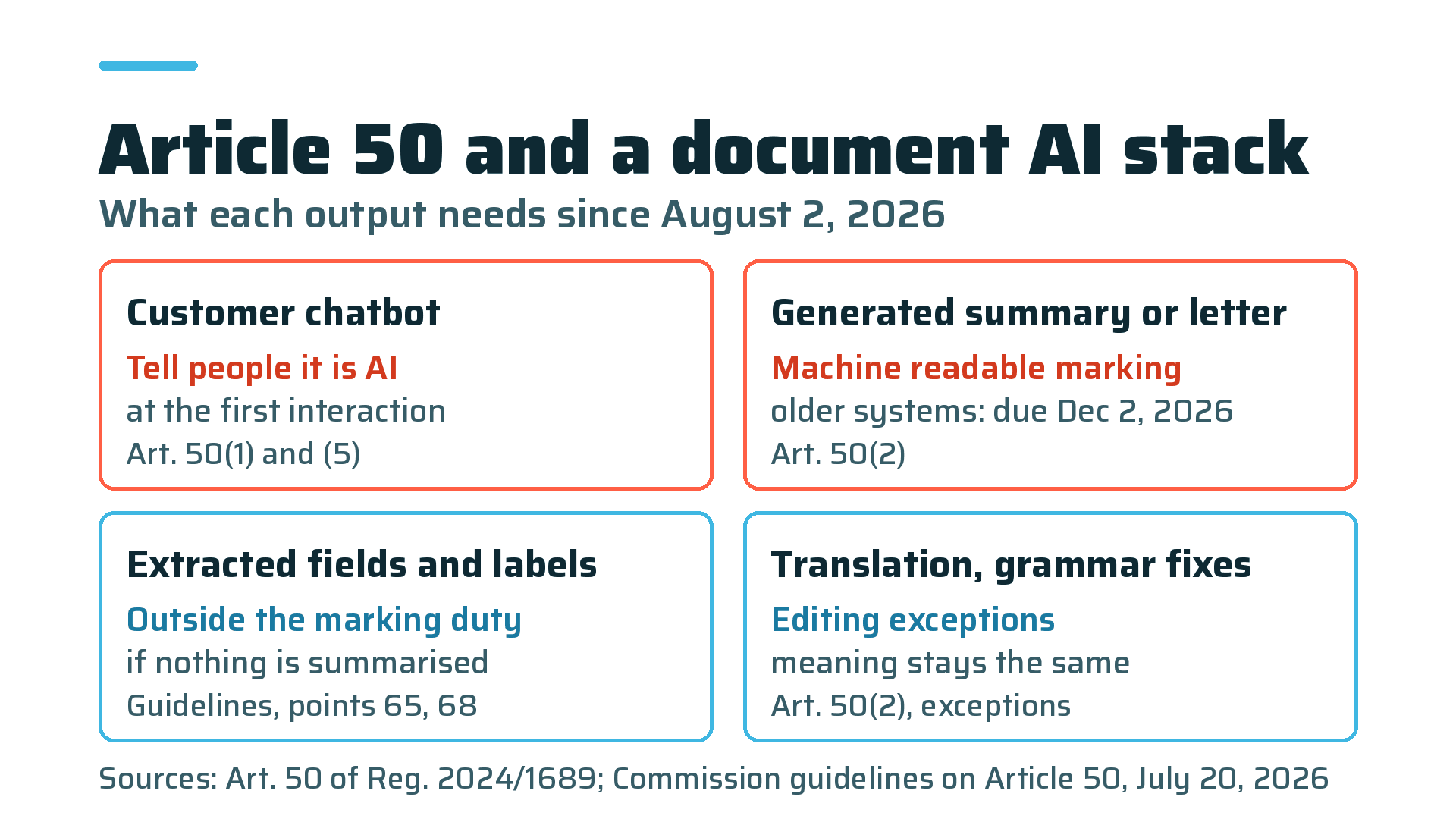
Article 50(2) requires providers of systems that generate synthetic text, images, audio or video to mark outputs in a machine readable format. Point 65 of the guidelines places outside it "AI systems used in internal analytical processes that extract and structure data, but do not summarise it", and point 68 excludes short outputs such as data labels. AI generated summaries do need marking, while grammar correction and translation are listed among the exempt edits and minor alterations.
So a claim summary written for an adjuster or a draft letter to a borrower needs a marker, and an extracted IBAN or a document class label does not. A breach of Article 50 can cost up to EUR 15 million or 3% of worldwide annual turnover, whichever is higher (Article 99(4)); for SMEs and small midcap companies the lower of the two applies (Article 99(6) and (6a)). By the end of July 2026, about 190 organisations had signed the Code of Practice on Transparency of AI-generated Content, which the Commission found adequate.
Which document AI systems are likely Annex III
Annex III, point 5(b) covers systems "intended to be used to evaluate the creditworthiness of natural persons or establish their credit score", except those used to detect financial fraud. Point 5(c) covers "risk assessment and pricing in relation to natural persons in the case of life and health insurance". Motor, property and liability insurance are not on the list. The draft guidelines do count accident and sickness cover as health insurance, and credit life insurance sold with a mortgage or car loan as life insurance (points 316 and 318).
Under Article 6(3), an Annex III system is not high risk if it only performs a narrow procedural task, improves a completed human activity, detects deviations from earlier decisions without replacing the human assessment, or performs a preparatory task. Recital 53 gives three examples of a narrow procedural task: "an AI system that transforms unstructured data into structured data, an AI system that classifies incoming documents into categories or an AI system that is used to detect duplicates among a large number of applications." The draft guidelines add that sorting stops being narrow once it ranks documents or labels them as more or less useful for the decision (point 93).
So document sorting and extraction inside a credit file or an underwriting case are an Annex III use case that may be exempt. The provider has to document the assessment before the system goes live (Article 6(4)) and register the system in the EU database (Article 49(2)). The filter never applies to profiling, which the AI Act defines through the GDPR as including the evaluation of a person's economic situation and reliability, so scoring a consumer for credit cannot use it.
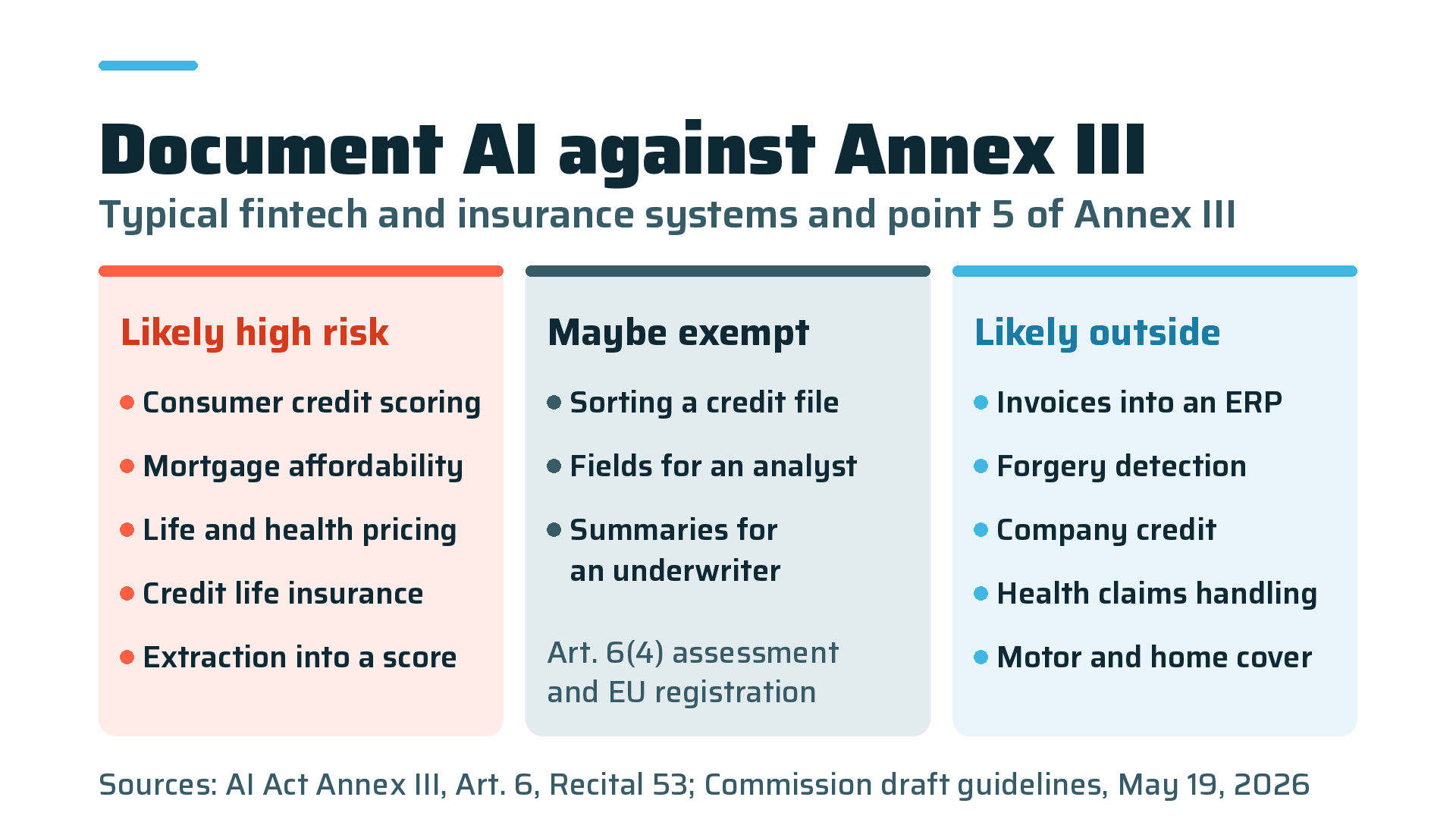
The Commission draft guidelines of May 19, 2026 add examples close to the systems we build:
- Likely high risk: consumer loan and mortgage scoring, credit agency scores shared with lenders, life underwriting on health and lifestyle data, and pricing of health cover for a risk group.
- Likely outside point 5(b): credit scoring of companies from balance sheets, margin lending, premium credit cards and leisure loans (point 304), customer segmentation for marketing, collateral valuation, and monitoring of credit exposure after the loan is granted.
- Fraud exception: the typical example is detecting forged or altered ID cards, income statements and bank statements. Fraud detection has to be the main intended use. AML systems do not get the exception, but the draft places them outside point 5(b) unless they also assess creditworthiness (point 309).
- Insurance: health insurance claims management falls outside point 5(c). That point has no fraud exception, so a fraud feature inside an underwriting model stays high risk unless it is a distinct system.
Pipelines are harder. Point 75 of the draft says that when several AI components jointly and materially influence an individual decision, "split architectures are assessed as a whole." Point 76 keeps the exemption only for procedural functions that are genuinely separable and do not feed outputs that materially influence the case.
In our reading, an extraction service that feeds only an ERP or an archive is outside Annex III. The same service in a credit file, read by an analyst who makes the assessment, can rely on Article 6(3) with the paperwork above, and once it feeds an automated affordability score it becomes part of a high risk system. By the same reading, the claims triage and fraud scoring pipeline in our document AI guide for fintech and insurance stays outside point 5(c) as long as it does not price or underwrite life or health cover.
What to build now, even with the delay
December 2, 2027 is 378 days after this post. For a credit or underwriting system already in production, the work below touches data models, interfaces and release pipelines, and it can take most of that time.
1. Keep an inventory with an intended purpose per system. Record what each model or pipeline is meant to do, which Annex III point could apply and whether it profiles people. If you rely on Article 6(3), file the assessment and the registration described above; the Omnibus shortened the registration form but kept the duty.
2. Log every decision with inputs, versions and the reviewer. Article 12 requires high risk systems to allow automatic recording of events over their lifetime. Providers and deployers keep those logs for at least six months (Articles 19 and 26(6)), and financial institutions keep them with the documentation required by financial services law.
# Python 3.10+. One record per AI assisted decision, written to an append only store.
# Keep it at least six months (Art. 19 and 26(6)); banks keep it with their
# financial services records. Set a maximum too: output holds personal data
# (GDPR storage limitation), so plan expiry or crypto shredding per record.
from dataclasses import dataclass, field, asdict
from datetime import datetime, timezone
import hashlib, json

@dataclass(frozen=True)
class DecisionRecord:
    case_id: str
    system_id: str              # entry in your AI system inventory
    model_version: str          # provider model id plus your own build tag
    prompt_version: str         # git commit of prompts and extraction schema
    input_sha256: tuple[str, ...]  # hashes of source documents, never the documents
    output: dict                # extracted fields, label, score
    confidence: float
    reviewer_id: str | None     # person who confirmed or changed the output
    override_reason: str | None # reason code when the person disagreed
    ts: str = field(default_factory=lambda: datetime.now(timezone.utc).isoformat())

def sha256_file(path: str) -> str:
    with open(path, "rb") as f:
        return hashlib.sha256(f.read()).hexdigest()

def to_log_line(rec: DecisionRecord) -> str:
    return json.dumps(asdict(rec), sort_keys=True)
3. Make human oversight a control in the interface. Article 14(4) expects the person overseeing the system to watch for automation bias and to be able "to decide, in any particular situation, not to use the high-risk AI system or to otherwise disregard, override or reverse the output". In practice that is an override with a reason code, the source document next to every extracted field, and a way to stop the system. Our document classification pipeline reached 98.2% first pass accuracy and flagged the ambiguous 1.8% for human review, and in our reading that routing, with every correction logged, is the kind of control Article 14 describes.
4. Govern your test sets first. Under Article 10(6), for high risk systems that do not train models, the data quality criteria apply only to the testing data sets. In our reading, a team that only prompts a hosted model falls under that rule and needs a representative test set with documented provenance. A team that fine tunes, as we did in the classification project above, also has to meet the criteria for training and validation data.
5. Generate technical documentation from the repository. Article 11 and Annex IV ask for a description of the system, its data, its testing and its oversight measures. Keep model and prompt versions, evaluation reports and architecture notes in version control and build the document per release.
6. Ship Article 50 disclosure and marking now. Show the AI notice before the first chatbot message, and mark generated summaries and letters in machine readable form, for example in document metadata and in a field of your API response. If the feature went live before August 2, 2026, the Commission reads the deadline as December 2, 2026 (Article 50 guidelines, point 153), 13 days after this post.
7. Prepare the deployer side with your client. From December 2, 2027, banks and insurers that deploy systems under points 5(b) and 5(c) must run a fundamental rights impact assessment (Article 27), which may now reuse parts of their GDPR impact assessment. They must also tell people that a high risk system is used on them (Article 26(11)). Article 86 adds a right to an explanation of the role of the system in a decision; the Omnibus did not move it, so ask your legal team when it starts to apply to your systems.
8. Put the model supplier in the contract. Article 25(4) requires a written agreement on information and technical access between the provider of a high risk system and the third party that supplies a tool or component, and the Omnibus added AI models to that list. Ask your LLM vendor for model change notices, evaluation data and incident contacts.
What is not settled yet: the classification guidelines are a draft, and the final version may move examples between the columns above. The Omnibus cites delayed standards as a reason for the move, so check which standards exist before you design to one. We will update this post when the classification guidelines are adopted.
Where we can help
We build intelligent document processing pipelines and custom AI systems for fintech and insurance teams, with logging and human review designed in from the start.
Frequently Asked Questions
EU AI Act readiness check for document AI
We map your document pipelines to Annex III and Article 50, review logging and human oversight, and give you a build plan for the December 2027 deadline.
Book a free technical validationSources
Dates and article numbers come from the Official Journal texts, read in the Publications Office repository on November 1, 2026. Everything else is attributed in the text.
- Regulation (EU) 2026/1744 (Digital Omnibus on AI), Official Journal L, July 24, 2026
- Regulation (EU) 2024/1689 (AI Act), Official Journal L, July 12, 2024
- European Commission, AI Act policy page and AI Omnibus enters into force, July 27, 2026
- AI Act Service Desk, Timeline for the implementation of the EU AI Act and When does enforcement start?
- European Commission, Guidelines on transparency obligations under Article 50, July 20, 2026
- European Commission, Code of Practice on Transparency of AI-generated Content and Commission opinion on its adequacy, July 2026
- European Commission, Draft guidelines on the classification of high risk AI systems, May 19, 2026, and AI Act Service Desk examples for essential services
- Pinsent Masons, Out-Law, Rules for high risk AI delayed under EU omnibus deal, May 7, 2026