On October 14, 2026, Next.js released 16.4.1 and 15.5.28 to fix two critical remote code execution bugs and one high severity denial of service (Next.js). By November 1 the vercel/next.js repository had published 44 security advisories in 2026, five of them critical (GitHub).
This post covers the October and August releases, the React Server Components advisories, sharp and its native libraries, and a Node.js Brotli bug that CISA lists as exploited. It takes the AVIF bug apart step by step and ends with the checklist we ran against our own Next.js sites in October.
Status on November 1, 2026: the newest fixes were in Next.js 16.4.1 and 15.5.28 (the latest 16.x release was 16.4.3), sharp 0.35.5 and Node.js 22.23.4, 24.22.1 and 26.12.1. On October 27 Next.js announced a scheduled release for November 3 to "address seven medium vulnerabilities". Read every version below as the floor on November 1.
Key takeaways
- 44 advisories were published in vercel/next.js in 2026 up to November 1, 5 critical and 15 high. The October 14 fixes need at least 16.4.1 or 15.5.28.
- Only 16.x and 15.x get fixes, 15.x through January 31, 2027. Version 14.x got none in 2026, though at least 24 advisories cover 14.2.35.
- Two critical bugs live in libraries bundled with sharp. Next.js 15.5.28 still accepts sharp 0.34.x, and we reproduced an install that loads sharp 0.34.5 with the unfixed librsvg 2.61.2.
- Node.js CVE-2026-111497 (Brotli) has been in the CISA KEV catalog since October 27 and is fixed in 22.23.4, 24.22.1 and 26.12.1. Node.js 20 gets no fix.
- On Vercel, image optimization runs in a central service, but
use cache, Server Actions and outboundfetch()run in your own functions, so apps on Vercel need the upgrade too.
Five critical advisories in ten months
Next.js published advisories on ten dates between January 26 and October 14. Since July 13 it announces security releases about once a month with the date and the highest severity, keeping ad hoc releases for urgent cases such as September 22 and October 14 (Next.js). The five critical advisories:
- August 25, AVIF in image optimization (GHSA-2xp9-vwfh-vxw4), a libheif bug reached through sharp.
- August 25, Windows hosted servers (CVE-2026-75604), fixed in 16.3.3 and 15.5.24. Backslashes in route segments let a request traverse outside the cache directory and expose the server reference manifest encryption key.
- September 22,
next/og(CVE-2026-94545), the Node.jsImageResponsewith attacker controlled values in SVG, fixed in 16.3.6. - October 14,
use cachereturning typed arrays (GHSA-673q-mjm6-r5xr), 16.x only, fixed in 16.4.1. - October 14, SVG in image optimization (CVE-2026-96889), a use after free in librsvg, fixed in 16.4.1 and 15.5.28 through sharp 0.35.5.
Of the 15 high severity advisories, six are denial of service bugs in Server Components, Server Actions and Cache Components, five are middleware or proxy bypasses and four are server side request forgery.
The October 14 release, issue by issue
Two of its three fixes were postponed from September 30 "due to upstream coordination" (Next.js).
use cache RCE (GHSA-673q-mjm6-r5xr, critical, CVSS 4.0 score 9.5). It hits App Router apps on 16.0.0 to 16.4.0 with Cache Components when a use cache function returns multiple typed arrays. The upstream React advisory says it "only affects extremely rare cases where responses transport multiple typed arrays and an attacker-controlled value" (React). Next.js still asks 16.x users to upgrade "even if your application does not have similar functions".
SVG RCE (CVE-2026-96889, critical 9.5 according to Next.js). A use after free in librsvg, triggered by nested XInclude elements with duplicate entity declarations (CVE), allows RCE on Linux with glibc; Next.js names sharp 0.35.5 as the workaround. Red Hat, which assigned the CVE, scores it 7.8 with a local attack vector; in our reading the Next.js score counts the network path through /_next/image.
Server Actions DoS (GHSA-p3m5-59mp-jv5r, high, 8.2). Crafted requests to an App Router app with at least one Server Action burn CPU and block "processing of further requests in the same process". The range starts at 13.0.0 and the July fix for an earlier Server Actions DoS does not cover it.
How a crafted AVIF file becomes a heap overflow
Vercel describes the chain: <Image> calls /_next/image, which calls sharp, which calls libvips, which uses libheif to decode the AVIF (Vercel).
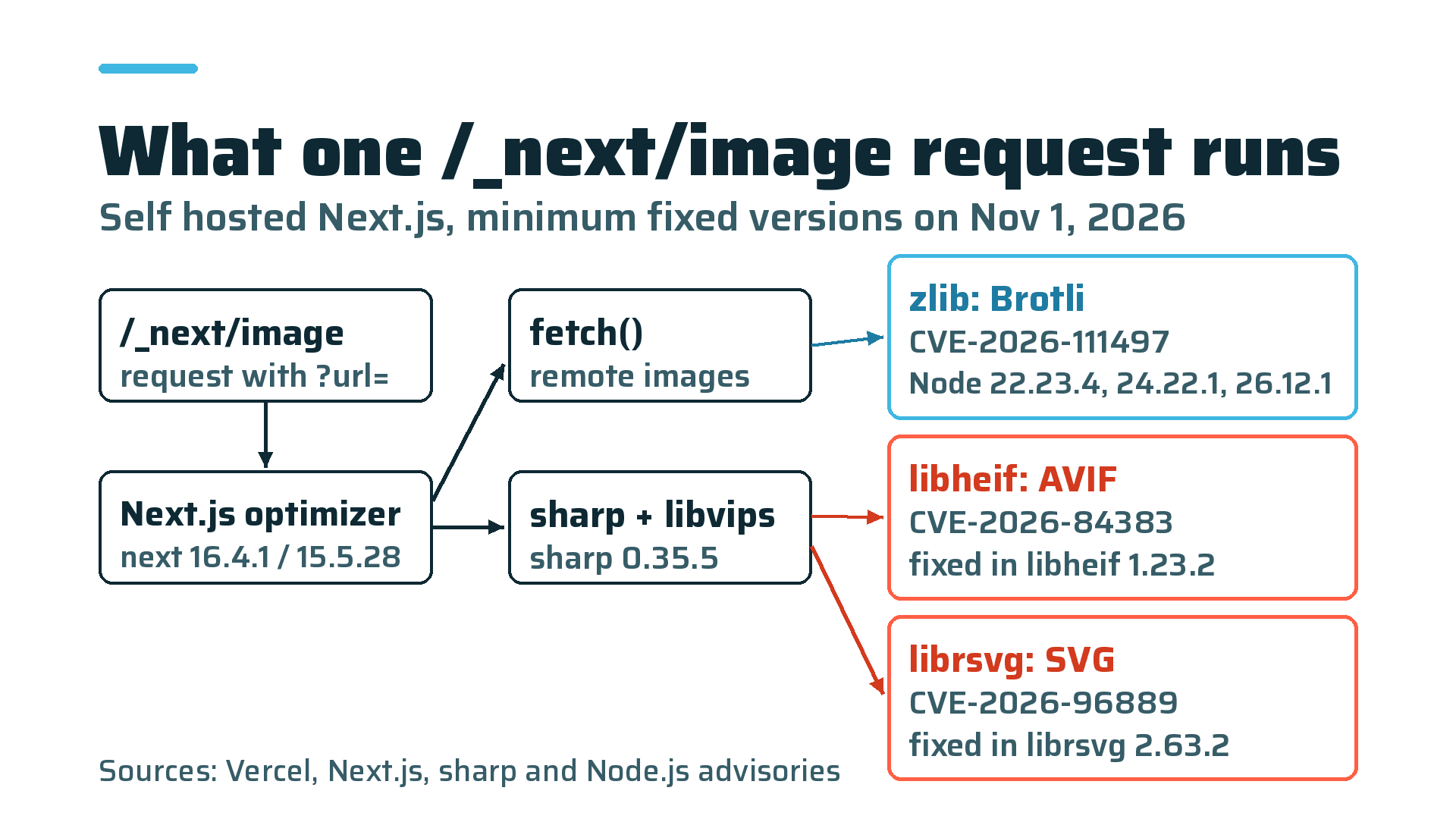
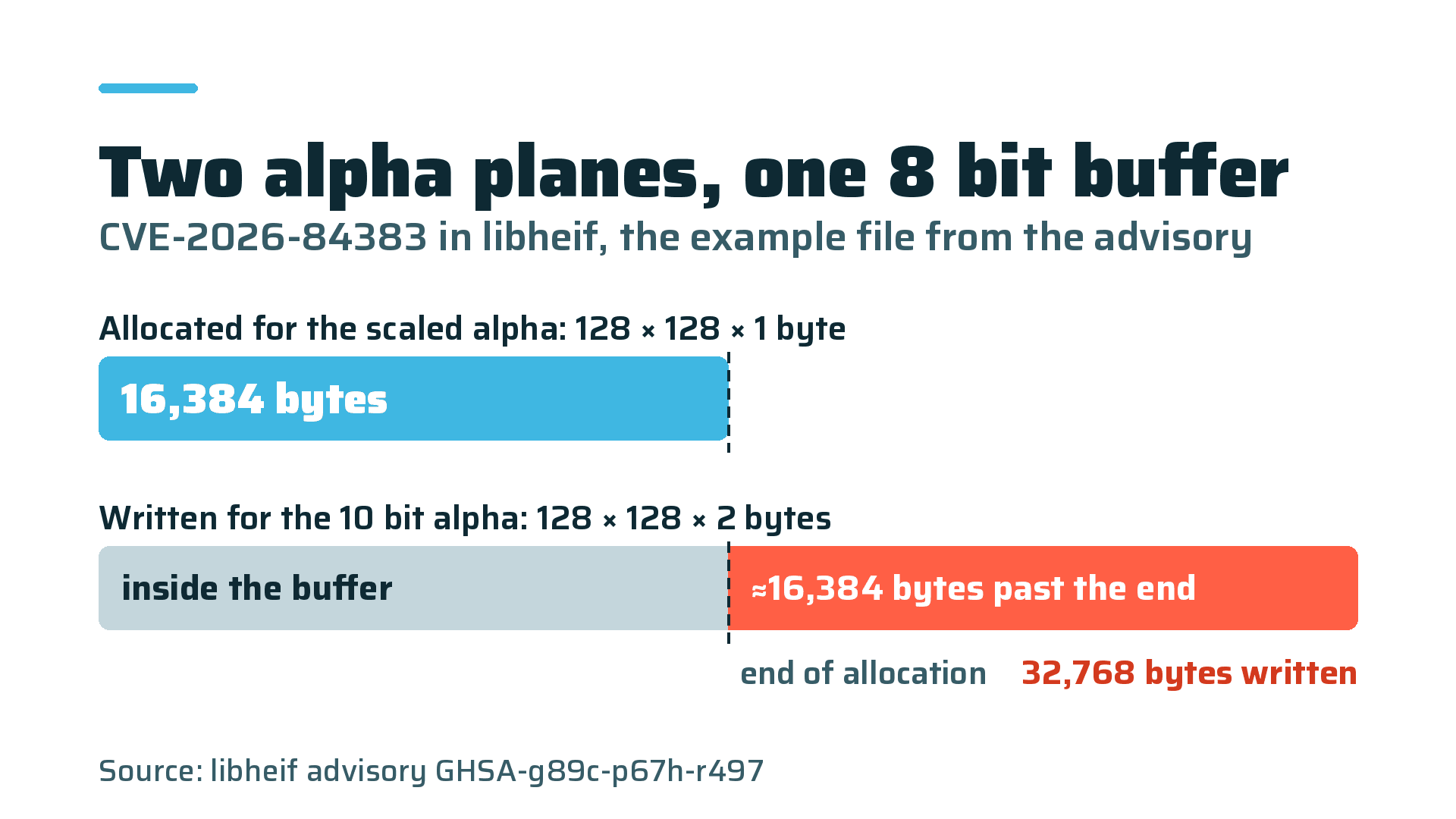
The libheif advisory GHSA-g89c-p67h-r497 (CVE-2026-84383, CVSS 3.1 score 9.8) calls the bug "a chain of four individually benign behaviors that combine into a controlled heap-buffer-overflow" (libheif). The path, with the example file from the advisory:
- The request. The attacker gets
/_next/imageto load their file, for example from a host inimages.remotePatternsor a path they can upload to (our reading of the preconditions). - The item graph. Of five image items, the 128×128 primary takes its alpha from an
idenitem (an identity derivation) that points at a 64×64 image with an 8 bit alpha and carries its own 10 bit alpha. - Two alpha planes. Decoding the
idenitem returns the referenced image with its alpha, then adds the second one, becausetransfer_channel_from_image_as()does not reject a channel that already exists. - The wrong size. The
idenitem declares 64×64 while the primary is 128×128, soscale_nearest_neighbor()rescales the alpha, sizing the destination from the first, 8 bit plane: 128 × 128 × 1 = 16,384 bytes. - The overflow. The loop then reaches the 10 bit plane, treats the same buffer as
uint16_tand writes 32,768 bytes into it, so roughly 16,384 bytes land past its end. - Attacker control. According to the advisory, the output geometry sets how far the write overflows and the 10 bit sample values set the bytes written.
- From write to code. Hacktron and Vercel reproduced RCE against a current Next.js build in August. The sharp maintainers recommend a
nodebinary built as a Position Independent Executable (PIE) and warn that official Node.js binaries are not PIE (sharp).
The fix shipped in libheif 1.23.2 on August 25 and sharp 0.35.4 on August 26, while Next.js 16.3.3 and 15.5.24 turned AVIF optimization off. In the source we read, 16.4.1 decodes AVIF again and relies on its sharp ^0.35.5 requirement, and 15.5.28 unblocks the decoder only when sharp reports libheif 1.23.2 or later. Removing image/avif from images.formats is no fix in our reading: it picks output formats, and the bug sits in decoding input.
The sharp copy matters more than the Next.js version
For both image bugs the fix is a sharp release: 0.35.4 for libheif and 0.35.5 for librsvg (sharp). Next.js 16.4.1 requires sharp ^0.35.5, while 15.5.28 accepts ^0.34.3 || ^0.35.5 (npm), because sharp 0.35 needs Node.js 20.9 and the 15.x line still supports Node.js 18.
Next.js says that upgrading "ensures package managers automatically provide a fixed version of sharp", and a fresh install did that in our test. When the project already depends on sharp 0.34.x, through a CMS or its own image code, npm deduplicates: our next@15.5.28 install next to sharp 0.34.5 loaded sharp 0.34.5 with librsvg 2.61.2. Version 15.5.28 checks the libheif version before it decodes AVIF but has no such check for librsvg, while npm audit flagged the stale sharp with all three of its 2026 advisories.
The same advisories name glibc and say nothing about musl, so we would not treat Alpine as safe. When we checked official images on November 1, the node binary was not a PIE in the two Debian based slim images we tested and was one in node:24-alpine.
React Server Components: the fix ships inside next
React published six advisories for react-server-dom-webpack, react-server-dom-turbopack and react-server-dom-parcel in 2026: five denial of service bugs and the critical RCE GHSA-xqc2-xf4c-x3h3 of October 14, fixed in 19.0.9, 19.1.10, 19.2.9 and 19.3.1. Next.js ships compiled copies of React and react-server-dom-webpack inside the next package, and its advisories give Next.js versions as the fix. In our next@16.4.3 install the bundled React reported 19.3.0-canary-278794d7-20261002, while npm ls react showed 19.3.1.
CVE-2025-55182, the December 2025 React Server Components RCE that Next.js calls React2Shell (CVSS 10.0), has been in the CISA Known Exploited Vulnerabilities catalog since December 5, 2025, with known use in ransomware campaigns (CISA). Current 15.5 and 16.4 releases contain its fix. Next.js asked teams whose apps were online and unpatched on December 4, 2025 at 1:00 PM PT to rotate their secrets (Next.js).
Which Next.js release lines still get security fixes
The support policy lists 16.x in Active LTS and 15.x in Maintenance LTS (Next.js). Maintenance for 15.x was due to end on October 21, 2026, and the page now says Next.js will "continue publishing security releases for Next.js 15 through Jan. 31, 2027". Since March, every 15.x fix has shipped as a 15.5 patch and every 16.x fix as a patch to the newest minor, so a team on 16.2.x has to move to 16.4 for the October bugs.
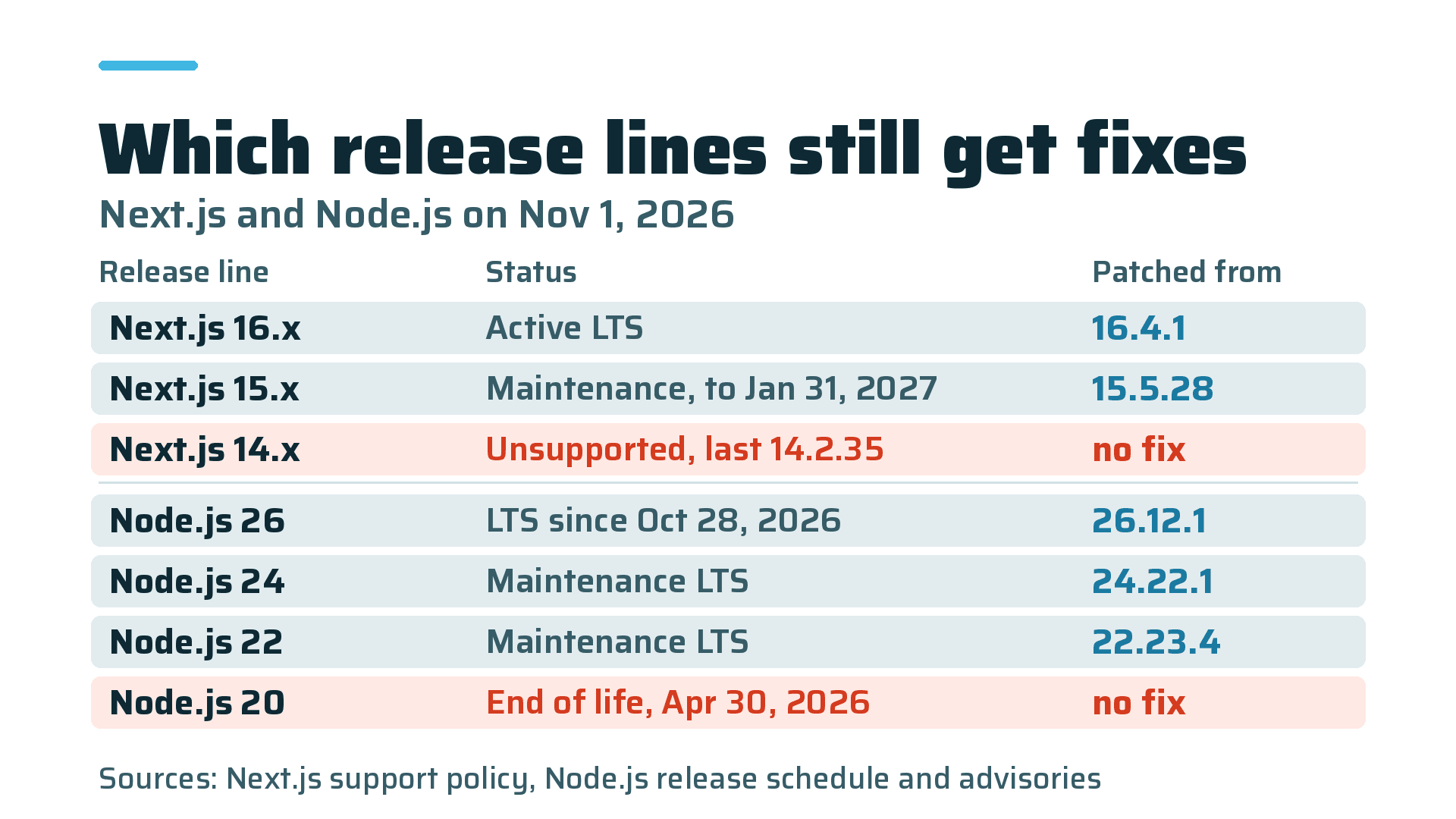
Version 14.x is unsupported, and its last release is 14.2.35 from December 11, 2025. Of the 44 advisories published by November 1, at least 24 declare affected ranges that include 14.2.35, three of them critical and nine high, and none lists a fixed 14.x version. For a 14.x app the fix is a migration to 15.5 or 16.4.
Node.js and Docker: the Brotli fix lives in the runtime
On October 21, Node.js shipped 22.23.4, 24.22.1 and 26.12.1 to fix CVE-2026-111497 in its bundled Brotli decoder, which treated an invalid block switch as a need for more input and kept appending bytes to an eight byte internal buffer (Node.js). The advisory says an attacker "who can supply Brotli data that an application decompresses with node:zlib can corrupt process memory", which can end in a crash, disclosure of process memory, or remote code execution.
Node.js rates it high, and Google, which assigned the CVE, scores it 9.2 under CVSS 4.0. CISA added it to the KEV catalog on October 27, 2026, with a due date of November 10 (CISA), and its enrichment of the CVE record marks exploitation as active (CVE).
Node.js fetch() decompresses Content-Encoding: br responses on its own, which we confirmed locally, and Vercel notes that Next.js "does not block Brotli responses in image optimization" and that only the runtime patch covers fetched responses (Vercel). On October 25 Cloudflare added a managed rule for requests to /_next/image for this CVE, in Log mode by default (Cloudflare).
A container keeps the Node.js binary it was built with: moving tags such as node:22 reach your image only when you pull and rebuild, and a pinned exact version never moves. Node.js 20 reached end of life on April 30, 2026 and the node:20 images we pulled on November 1 still shipped 20.20.2; the advisory repeats that end of life versions "are always affected when a security release occurs". Step 4 of the checklist reads the version inside the running container.
Self hosted and Vercel are exposed in different places
- Image optimization. On Vercel, images go through a central Image Optimization Service, where AVIF was off from August 13, and for August Vercel said apps needed "No upgrades, configuration changes, or redeploys" (Vercel). Its changelog has no such entry for the October SVG bug. A self hosted server decodes with the sharp copy in its own
node_modules. - Code inside your functions.
use cache, Server Actions and outboundfetch()run in your deployment on any host, so apps on Vercel need 16.4.1, 15.5.28 or a later release as well. - The Node.js runtime. Vercel says new deployments since October 28 at 11:00 PT use a patched Node.js, projects on 20.x must move to 22.x or 24.x, and its WAF "does not cover responses your functions fetch from other servers". Self hosted, the runtime is whatever your base image contains.
- Windows. CVE-2026-75604 needs a Windows filesystem; Vercel runs Next.js on Linux, and self hosted Windows servers have no workaround.
How we check a Next.js deployment
We ran this list against our own Next.js sites in October 2026. It starts from what is running, and every step prints a version or status to compare with the newest patched versions on the Next.js security blog.
1. Read the version from the running system, not from the lockfile. On the live site, window.next.version in the browser console shows the version the client bundle was built with; inside the container, ask the app directory. In one audit we ran in October, the lockfile was kept out of git, so no file in the repository described production.
2. Print the sharp copy that Next.js loads, resolved from the next package the way the optimizer does it.
# Inside the running container (works with output: "standalone" too)
docker exec -w /app <container> node -p "require('next/package.json').version"

# The sharp copy Next.js resolves, with its bundled native libraries
docker exec -w /app <container> node -e '
  const p = require.resolve("sharp", { paths: [require.resolve("next")] });
  const v = require(p).versions;
  console.log("sharp", v.sharp, "vips", v.vips, "heif", v.heif, "rsvg", v.rsvg);'
# Minimums on Nov 1, 2026: sharp 0.35.5, heif 1.23.2, rsvg 2.63.2
3. Run npm audit --omit=dev in CI on the lockfile you deploy. It flags both next and a stale sharp from the GitHub advisory database.
4. Check the runtime: Node.js version, libc and the Brotli fix. The BROTLI_DECODER_ERROR_FORMAT_BLOCK_SWITCH constant came with the October release: in our tests it printed -17 on 22.23.4, 24.22.1 and later and undefined on 24.22.0 and 20.20.2.
# Prints e.g. "v24.22.1 glibc:2.36 brotli-fix:-17"; glibc:undefined means musl (Alpine)
docker exec <container> node -p 'process.version + " glibc:" + process.report.getReport().header.glibcVersionRuntime + " brotli-fix:" + require("zlib").constants.BROTLI_DECODER_ERROR_FORMAT_BLOCK_SWITCH'
5. Map what can reach /_next/image. List local image sources and every host in images.remotePatterns, removing hosts whose DNS you do not trust (GHSA-cjq9-62q9-8jv4), and note dangerouslyAllowSVG, unoptimized or a custom loader.
6. List the features the advisories depend on, such as Cache Components, Server Actions and the Node.js ImageResponse. Upgrade anyway; the list tells you where to look first.
# Run in the repository root
grep -nE "images|remotePatterns|dangerouslyAllowSVG|unoptimized|loader|cacheComponents" next.config.*
grep -rlnE "['\"]use (cache|server)['\"]|ImageResponse" app src 2>/dev/null
ls middleware.* proxy.* src/middleware.* src/proxy.* 2>/dev/null   # middleware or proxy used for auth

# After the upgrade, on a local build only: the optimizer must still answer
curl -s -o /dev/null -w '%{http_code} %{content_type}\n' \
  'http://localhost:3000/_next/image?url=%2Fsome-local-image.png&w=640&q=75'
# Expect 200 and image/webp (or image/avif if you enabled it)
7. Rebuild on fresh base images and recreate the containers with docker compose build --pull and docker compose up -d --force-recreate, then repeat steps 1, 2 and 4 in the new container. Check CI too: in the same audit, one deployment workflow still built on Node.js 20.
8. Follow the primary sources. Watch the Next.js security blog, the GitHub advisories of vercel/next.js, lovell/sharp and facebook/react, and the Node.js vulnerability blog.
If you cannot upgrade today. The advisories list no workaround for the use cache RCE or the October Server Actions DoS. For the image bugs, images.unoptimized: true or an external loader keeps sharp away from attacker supplied files at the cost of optimization, our stopgap rather than an advisory one. The Cloudflare rules block nothing until you change their action from Log.
What we do not know yet. The SVG advisory does not say which path takes an SVG to librsvg; with dangerouslyAllowSVG off the optimizer answers SVG input with a 400, yet the SVG loader in sharp stays unblocked, so we do not count the flag as a mitigation. The libheif project shipped 1.23.6 and 1.23.7 in October with more advisories, while sharp 0.35.5 bundles libheif 1.23.5; neither project has said whether they are reachable. On November 1, the November 3 release was described only as fixes for "seven medium vulnerabilities".
If you run Next.js in production, our web development team builds and maintains Next.js applications, self hosted and on Vercel, and can run this checklist with your engineers.
Frequently Asked Questions
Next.js upgrade and security review
We check what your production servers actually run, plan the move to a patched release line and confirm that the app still starts and serves images afterwards.
Book a free technical validationSources
Version checks and container tests are our own, run on November 1, 2026.
- Next.js, October 14 security update and its advance notice, October 2026; August 2026 Security Release; November release notice, October 27, 2026
- Next.js, security release program, July 13, 2026; Support Policy, read November 1, 2026; CVE-2025-66478, December 2025
- GitHub, vercel/next.js security advisories, read November 1, 2026, including GHSA-673q-mjm6-r5xr, GHSA-2464-fhr4-w9xw, GHSA-p3m5-59mp-jv5r and GHSA-2xp9-vwfh-vxw4
- React, GHSA-xqc2-xf4c-x3h3 and GHSA-h3gv-c5rc-p453, October 14, 2026
- libheif, GHSA-g89c-p67h-r497, August 25, updated October 9, 2026; sharp, GHSA-rgj7-g3m4-5g8c, August 27, and GHSA-wq5f-xc86-pv6w, September 30, 2026
- Vercel, libheif disclosure post, September 18; August security release changelog, August 25; Node.js Brotli advisory, read November 1, 2026
- Node.js, October 21, 2026 Security Releases; CVE Program, CVE-2026-111497, CVE-2026-96889, CVE-2026-84383 and CVE-2026-75604
- CISA, KEV catalog, version 2026.10.30; Cloudflare, WAF Release 2026-10-25; npm registry, next 15.5.28 and next 16.4.1