Every engineering leader scaling a team in 2026 makes the same decision. Hire in house, send the work offshore to Asia, or build a nearshore team inside Europe. The cheapest option on a rate card is rarely the cheapest option on the final invoice, and the choice that looks safest can be the one that quietly drains the most time.
This is a direct comparison of the three models on the metrics that actually move a budget: hourly rate, fully loaded cost, hiring speed, time zone overlap, and project risk. The numbers below are 2026 market figures, and the conclusion is not "always nearshore." It is a framework for matching the model to your situation.
Key Takeaways
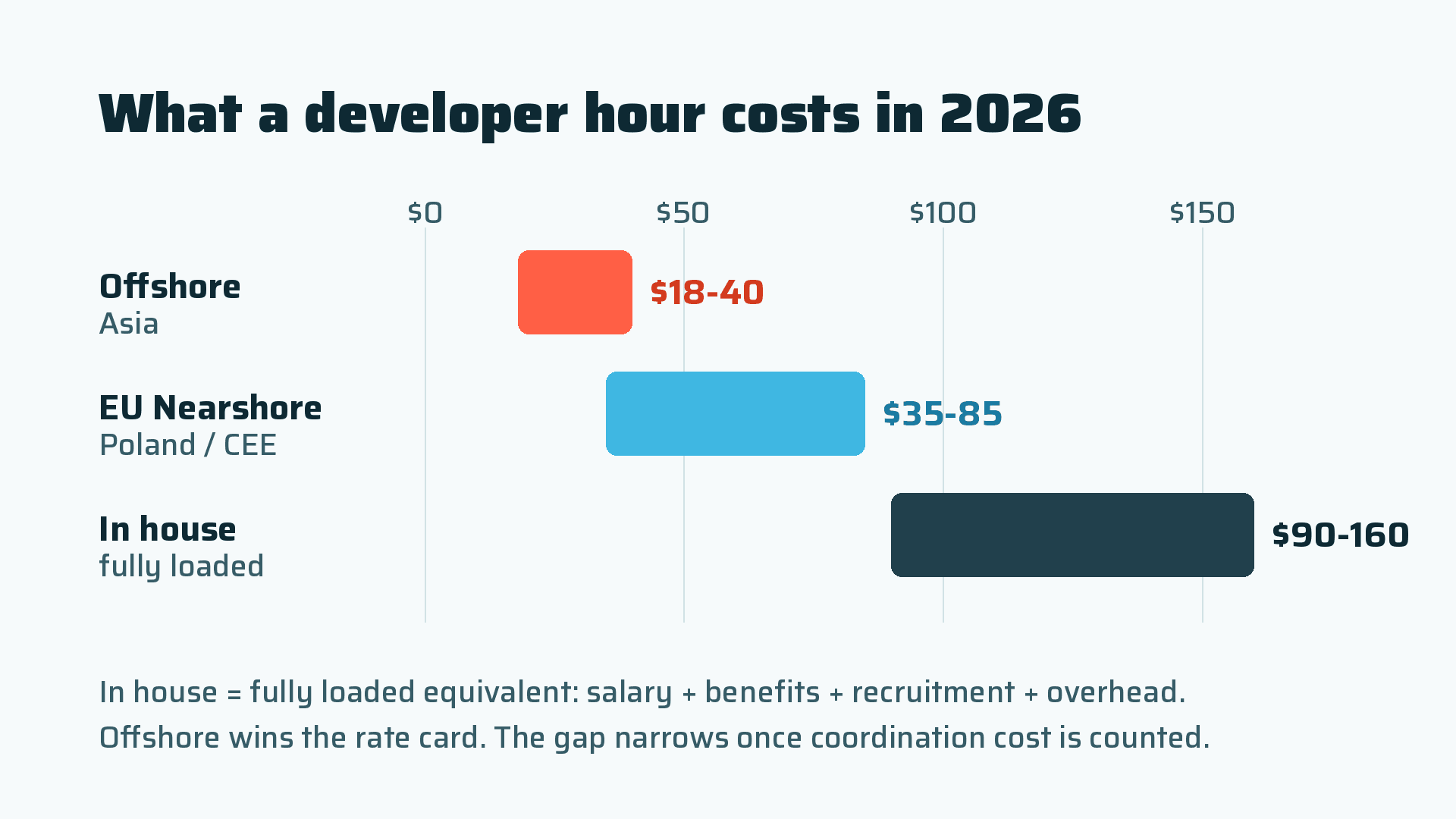
- Offshore development in Asia runs roughly $18 to $40 per hour, the lowest sticker price of the three models. EU nearshore sits at $35 to $85 per hour depending on seniority, and a fully loaded in house senior engineer in the West costs the equivalent of $90 to $160 per hour once benefits, taxes, and overhead are counted.
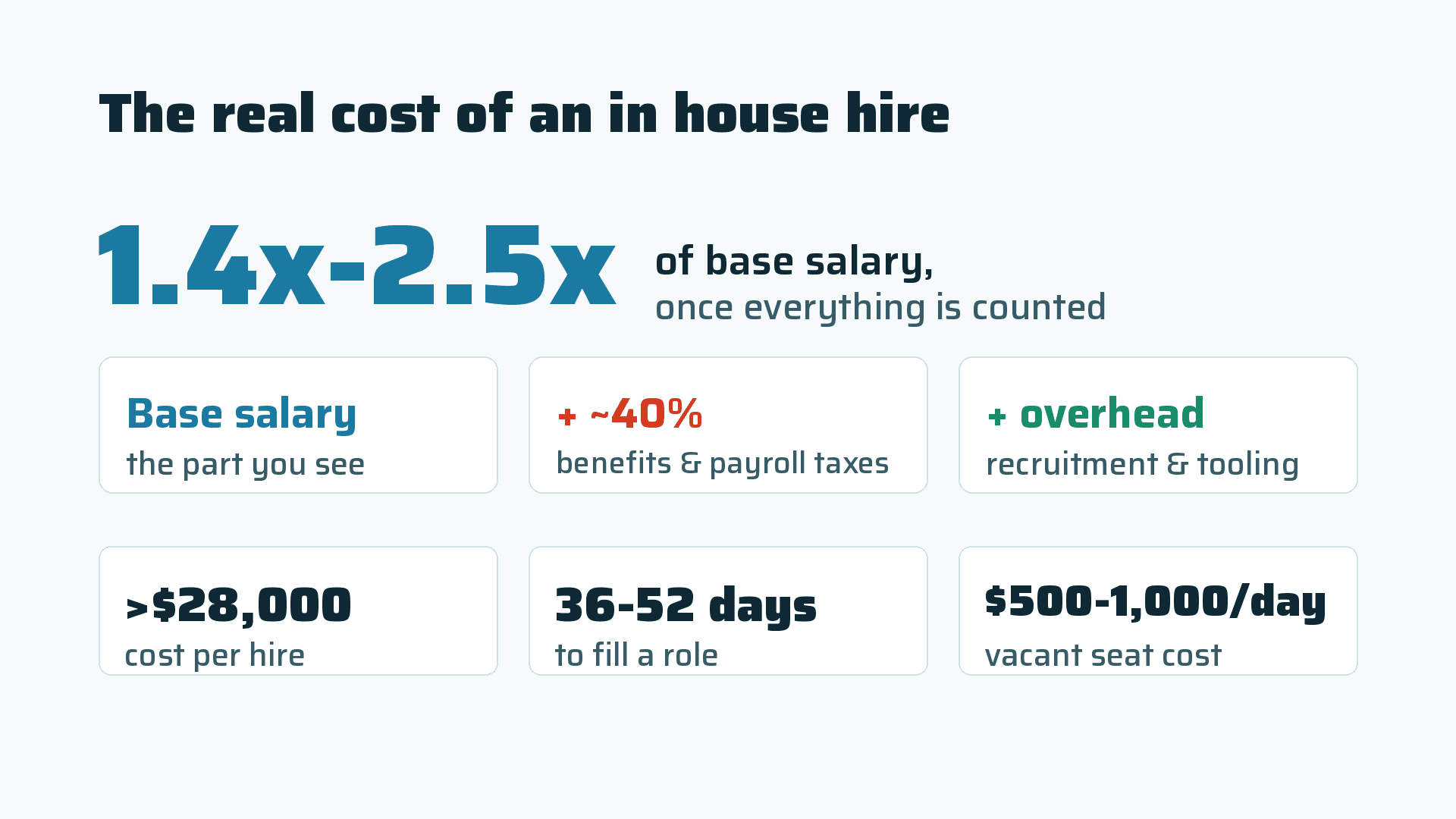
- The true cost of an in house hire is 1.4x to 2.5x the base salary after benefits, recruitment, and overhead. A US senior engineer often lands at $250,000 to $350,000 all in.
- Hiring is slow and expensive before any code ships. Average cost per hire for a developer now exceeds $28,000, and time to fill runs 36 to 52 days, with a vacant senior seat costing $500 to $1,000 per day in lost output by our estimates.
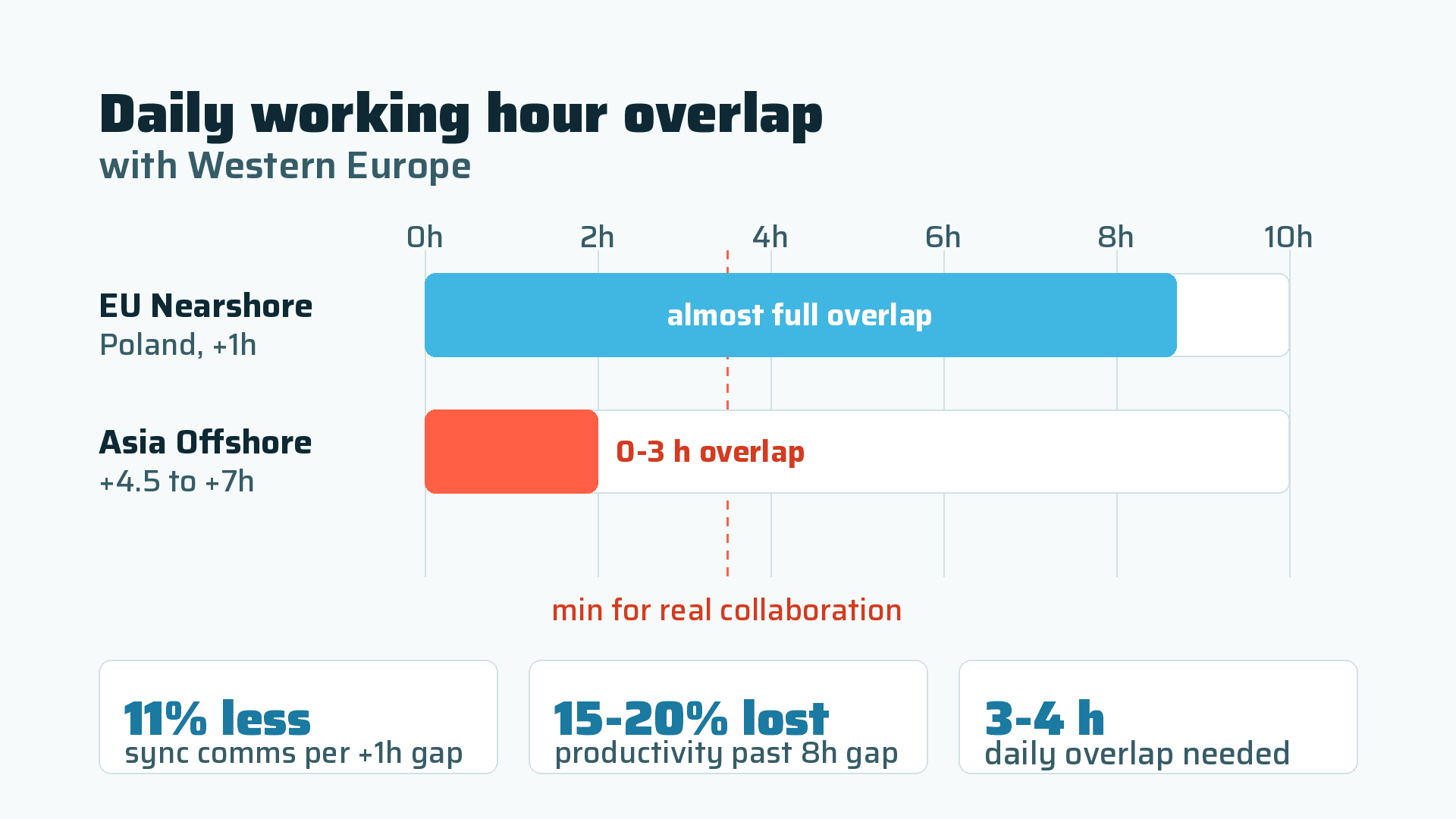
- Offshore savings erode through communication friction. A study in Organization Science found synchronous communication drops 11% for every additional hour of time zone separation, and teams with more than an 8-hour gap lose 15 to 20% of productivity.
- Effective collaboration needs 3 to 4 hours of daily overlap. EU nearshore gives Western European clients near total overlap and 5 to 7 hours with the US East Coast. Asia offshore typically gives 0 to 3.
- Europe has the talent depth to make nearshore a real option. Poland alone has more than 650,000 software developers and adds over 20,000 IT graduates a year, with its outsourcing market projected near $3.84 billion in 2026.
- The right answer depends on the work, not the rate. Offshore fits well specified, low coupling tasks. In house fits core IP and product strategy. Nearshore fits everything that needs both senior quality and daily collaboration without a Western payroll.
The Three Models, Defined
The terms get used loosely, so here is the distinction that matters for budgeting and risk.
In house means full time employees on your payroll, usually in your own country or region. You carry the salary, benefits, payroll taxes, recruitment, tooling, and management. You also keep the most direct control over priorities, IP, and culture.
Offshore means contracting a team in a distant, low cost region, most often South and Southeast Asia. The hourly rate is the lowest available. The trade off is a large time zone gap, longer communication loops, and more coordination overhead.
Nearshore means contracting a team in a nearby region that shares most of your working hours. For Western European and UK companies, that region is Central and Eastern Europe. For US companies, it usually means Latin America, though Europe is increasingly chosen for its seniority and engineering culture.
The decision is not really about geography. It is about what you are willing to trade between three things that pull against each other: hourly cost, time zone overlap, and the amount of management attention the engagement demands.
What Each Model Actually Costs in 2026
Start with the rate card, because that is where most comparisons begin and end. It should not.
Offshore teams in India, Vietnam, and the Philippines charge $18 to $40 per hour for standard development roles. That is the headline advantage, and it is real.
EU nearshore teams in Poland and the wider CEE region charge $35 to $55 per hour for mid level engineers and $60 to $85 for seniors. That is roughly 1.5x to 2.5x the Asian rate, and the premium buys EU data protection, strong English, and overlapping hours.
In house is where the rate card stops being useful. A senior engineer in Western Europe or the US does not cost you their salary. They cost you their fully loaded total, which is a different number entirely.
The Hidden Cost of In House Hiring
An in house developer is the most expensive line on this list, and most of the cost is invisible on the offer letter.
Benefits and payroll taxes add roughly 40% on top of base salary before anything else. Layer in recruitment, onboarding, tooling, and management overhead, and the true cost reaches 1.4x to 2.5x the salary. A US senior engineer who signs for a $180,000 salary can cost $250,000 to $350,000 a year all in. A mid level developer lands closer to $180,000 to $220,000 fully loaded.
Then there is the cost of the search itself. The average cost per hire for a developer now exceeds $28,000, and it can double for senior or specialized roles. External recruiter fees alone run 15% to 25% of annual salary.
The slowest cost is the one leaders forget. Time to fill for a developer role runs 36 to 52 days, and in our experience a vacant senior seat costs $500 to $1,000 per day in delayed roadmap and lost output. A team that takes four months to fill a critical role has burned $60,000 to $100,000 in opportunity cost before that person writes a line of code.
None of this argues against in house hiring. It argues against treating salary as the cost. For your core product team, that total is worth paying. For surge capacity or a well scoped module, it rarely is.
Why Offshore Savings Often Evaporate
Offshore wins the rate card and then spends the savings on coordination. The mechanism is well documented.
Communication degrades with distance in a measurable way. A study published in Organization Science found that synchronous communication drops 11% for every additional hour of time zone separation. Teams separated by more than 8 hours lose an estimated 15 to 20% of productivity to delayed responses and handoff gaps.
Effective collaboration needs 3 to 4 hours of daily overlap. An offshore team 9 to 12 hours away gives you almost none. A question asked at the end of your day gets answered at the end of theirs, which means a one day round trip on a decision that should take ten minutes.
The financial impact compounds at the project level. Research shows 70% of software projects exceed their budget by 27% to 45%, and the Project Management Institute attributes 56% of the dollars at risk on a project to communication breakdowns. Distance does not cause every overrun, but it amplifies the ones that start small.
Offshore is the right tool for work that does not need a daily conversation. A well specified API integration, a defined batch of test automation, a maintenance backlog. The moment the work needs frequent decisions, the rate advantage starts paying for itself in delay.
Where EU Nearshore Wins
EU nearshore is not the cheapest and it is not the most controlled. It is the model that refuses to make you choose between senior quality and daily collaboration.
The talent depth is the foundation. Poland has more than 650,000 software developers and produces over 20,000 IT graduates a year from technical universities. The Polish software outsourcing market is projected to reach roughly $3.84 billion in 2026, and more than 35% of Western and Nordic European firms plan to increase their nearshore use over the next two years.
Three advantages stack up for a buyer in Western Europe or the UK.
Time zone overlap is near total. A team in Poland shares your entire working day. Standups happen live, code review happens same day, and a blocker raised at 10am is unblocked before lunch. The 11% per hour communication penalty barely applies.
EU data protection is built in, not bolted on. A nearshore team inside the EU operates under the same GDPR regime as you do. There is no cross border transfer question and no separate compliance review for where the data lives. For regulated industries, that alone can decide the model.
Engineering culture and English are strong. The premium over Asian rates buys senior engineers who push back on bad requirements, write maintainable code, and communicate in clear English. That reduces the rework that quietly inflates a cheaper engagement.
The result is a middle path that behaves like an extension of your own team while costing a fraction of a Western in house hire. You skip the $28,000 cost per hire and the 52-day search, and you onboard in days rather than months.
A Decision Framework: Which Model Fits Your Situation
Rate cards do not make this decision. The nature of the work does. Use these signals.
Choose in house when the work is your core IP, your durable product strategy, or your founding engineering culture. These roles justify the fully loaded cost because the value compounds and the knowledge must stay inside the company.
Choose offshore when the work is well specified, loosely coupled, and tolerant of a one day feedback loop. Maintenance backlogs, defined integrations, test automation, and overflow on a clear spec are good fits. The rate advantage is real when coordination demand is low.
Choose EU nearshore when the work needs senior quality and daily collaboration but does not justify a Western payroll. Building a new product module, scaling an existing team quickly, or covering a skill gap for two quarters all fit. This is the largest category for most growing companies, which is why the nearshore market is expanding fastest.
Most teams end up with a blend. A small in house core for product and architecture, a nearshore team for build velocity and surge capacity, and selective offshore for well bounded maintenance. The mistake is not picking the wrong single model. It is forcing one model onto every kind of work.
How Oligamy Structures Nearshore Engagements
Oligamy is an EU software house based in Gdańsk, Poland, which puts us in the nearshore tier for Western European, UK, and US clients. Two engagement models cover most of the decisions above.
A dedicated development team is a full nearshore squad that operates as an extension of your organization, with overlapping hours, EU data protection, and senior engineers who own outcomes rather than tickets. This fits a new product build or a long running scale up.
Staff augmentation places individual senior engineers into your existing team to cover a specific skill gap or add capacity for a defined period, without the $28,000 cost per hire or the multi month search.
If you are weighing the three models for a specific project, the fastest way to get a concrete answer is our free technical validation, where we scope the work and tell you which model actually fits before any commitment.
Frequently Asked Questions
Not sure which model fits your roadmap?
We scope the work and tell you whether in house, nearshore, or offshore fits, before any commitment.
Get a free technical validationFor a deeper look at how we build production AI inside the EU, see our Enterprise Document Classification case study. To discuss which model fits your roadmap, talk to our team.