Multi-Currency Stablecoin System: FRAX Fork Architecture
We built a multi-currency stablecoin system that mints USD, EUR, GBP, and GOLD-pegged tokens from a single protocol. The base is a modified FRAX fork with custom collateral logic, a private UniswapV2 deployment, and dual oracle price feeds. This post covers the architecture decisions, the stabilization math, and how we handled de-peg protection without manual intervention.

Why FRAX as the Base Layer
Most stablecoin development projects start from scratch or fork a simple collateralized model like MakerDAO. We chose FRAX for a specific reason: its fractional-algorithmic design lets us adjust the ratio of collateral to algorithmic backing per-token, per-market condition.
FRAX's core mechanism works on a collateral ratio (CR) that floats between 0% (fully algorithmic) and 100% (fully collateralized). When demand is high and the peg holds, the protocol can reduce CR, meaning less capital locked per minted token. When confidence drops, CR rises automatically, increasing hard collateral backing.
We forked FRAX v1 and extended it in three ways:
Multi-currency peg targets. The original FRAX tracks USD only. We added EUR, GBP, and XAU (gold) peg targets, each with its own collateral ratio and oracle configuration. This means the EUR stablecoin can operate at CR 85% while the GOLD token runs at CR 95%, because gold price volatility demands tighter backing.
Custom collateral pool logic. FRAX v1 accepts USDC as collateral. Our fork accepts ETH and BTC (wrapped), which changes the risk model entirely. Volatile collateral backing a stable peg requires over-collateralization buffers and faster rebalancing cycles, which we cover in the de-peg protection section below.
Governance token redesign. FRAX uses FXS as its governance and value-accrual token. We deployed a custom governance token that serves three functions: absorbing volatility during CR adjustments, rewarding liquidity providers, and voting on protocol parameters like per-currency CR floors.
For teams evaluating how to build a stablecoin system, the fork-vs-build decision comes down to audit surface. A FRAX fork inherits years of battle-tested logic. Our modifications sit in isolated modules, which means the core minting and redemption paths remain close to the audited original.
Custom UniswapV2: Why We Deployed Our Own DEX Instance
The system needs on-chain price discovery for each stablecoin pair. We could have listed tokens on public Uniswap or SushiSwap, but that creates three problems for a multi-currency stablecoin protocol:
Liquidity fragmentation. On a public DEX, our pools compete with thousands of other pairs for liquidity provider attention. A EUR/ETH pool with $200K TVL on public Uniswap gets buried. On our own deployment, it is the primary market.
Fee control. UniswapV2 hardcodes a 0.3% swap fee. Our deployment modifies this per pool. Stablecoin-to-stablecoin swaps (e.g., USD-stable to EUR-stable) run at 0.05% to encourage internal arbitrage. Stablecoin-to-ETH pairs run at 0.3% standard. This fee asymmetry incentivizes the behavior that keeps pegs tight.
Tokenomics integration. Swap fees on our DEX flow back to the protocol treasury and governance stakers, not to a third-party DAO. This closes the economic loop: users mint stablecoins, trade on our DEX, fees fund the collateral pool, collateral backs more stablecoins.
The deployment itself is a standard UniswapV2 factory and router contract set with modified fee distribution logic. We kept the AMM math (constant product x*y=k) identical to the original, because changing core AMM logic introduces pricing edge cases that take months to surface.
This approach to DeFi development prioritizes composability over novelty. The trading interface, analytics dashboards, and third-party integrations all work because UniswapV2's interface is a de facto standard. Forks of the router contract are compatible with any frontend that speaks UniswapV2.
Dual Oracle Price Feeds: Chainlink + On-Chain Data
A multi-currency stablecoin system needs accurate, tamper-resistant price data for four fiat currencies plus gold. We run two price feed sources in parallel and reconcile them on-chain.
Source 1: Chainlink oracles. Chainlink provides off-chain price feeds for EUR/USD, GBP/USD, and XAU/USD from aggregated exchange data. These feeds update on a heartbeat (typically every ~60 seconds for major pairs) or when price deviates beyond a threshold (usually 0.5% for forex, 1% for commodities). The strength: broad market coverage from centralized and decentralized exchanges. The weakness: latency. A 60-second heartbeat means the on-chain price can lag the real market by up to a minute.
Source 2: On-chain Uniswap TWAP. Our custom UniswapV2 deployment generates time-weighted average prices (TWAPs) from actual on-chain trades. These reflect real supply/demand on our protocol, updating with every block that includes a swap. The strength: zero latency relative to our own markets. The weakness: low-liquidity pools can be manipulated by large trades.
Reconciliation logic. The protocol uses Chainlink as the primary reference and TWAP as a sanity check. If the two sources diverge by more than a configurable threshold (default: 0.5% for forex pairs, 1.5% for XAU), the system flags a potential oracle manipulation or market dislocation and pauses minting for that currency until prices converge.
This dual-feed design addresses a real failure mode in DeFi development. Single oracle reliance has caused multiple protocol exploits. The Radiant Capital hack demonstrated what happens when price feed integrity is compromised. In our architecture, an attacker would need to simultaneously manipulate both Chainlink's decentralized oracle network and execute sustained on-chain trades on our DEX, which is economically impractical for forex pairs with deep off-chain liquidity.
For stablecoin development projects targeting multiple currencies, the oracle cost is non-trivial. Each Chainlink feed requires LINK token funding for the oracle network. Four currency pairs means four feeds, each costing roughly 10-20 LINK per month depending on update frequency. We budget this as a protocol operational expense, funded by DEX fee revenue.
Algorithmic Stabilization: How the Peg Holds
The stabilization mechanism is where the FRAX architecture earns its complexity. Each stablecoin maintains its peg through a combination of collateral backing and algorithmic expansion/contraction.
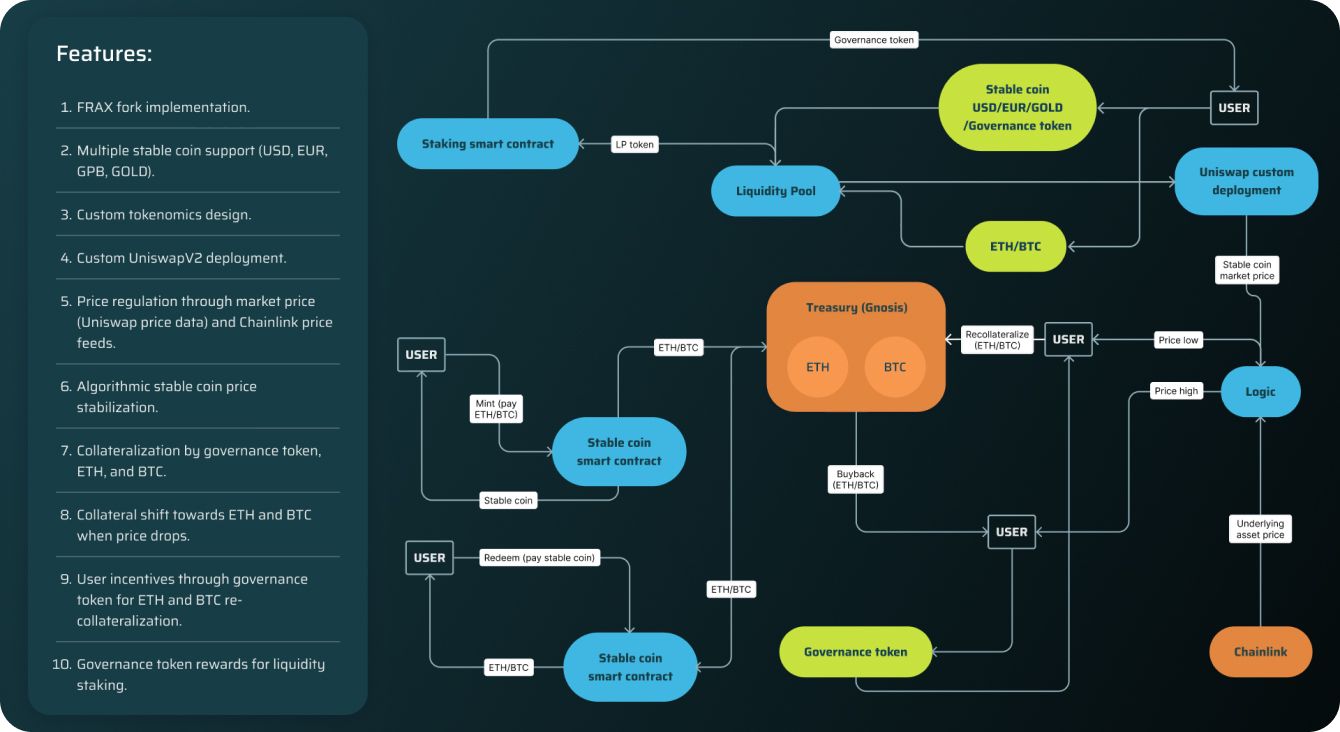
Minting. To mint 100 USD-stable tokens when CR is 85%, a user deposits $85 worth of ETH/BTC collateral plus $15 worth of governance tokens. The governance tokens are burned, reducing supply and (in theory) increasing governance token price. This is the algorithmic portion: the protocol creates stablecoin value partly from governance token burns rather than 100% from hard collateral.
Redemption. Redeeming 100 USD-stable returns $85 in ETH/BTC collateral plus $15 in newly minted governance tokens. The governance token supply increases, which dilutes holders but ensures the redeemer gets full value.
CR adjustment. The collateral ratio for each currency adjusts every hour based on a PID controller that tracks peg deviation. If USD-stable trades above $1.00 (demand exceeds supply), CR decreases by a step (default: 0.25%), making minting cheaper and encouraging supply expansion. If it trades below $1.00, CR increases, requiring more collateral per mint and discouraging supply growth.
The math behind each CR adjustment step:
CR_new = CR_current + (Kp * error) + (Ki * integral_error) + (Kd * derivative_error)
Where error = (target_price - market_price), and Kp, Ki, Kd are tuning constants set by governance vote. We set conservative defaults (Kp=0.2, Ki=0.05, Kd=0.1) that prioritize stability over responsiveness. Aggressive tuning would correct deviations faster but risks oscillation, which is worse than a slow return to peg.
This approach to algorithmic stablecoin design avoids the failure mode that killed UST/LUNA: pure algorithmic stabilization with no collateral floor. Our system always maintains a minimum CR (governance-set, default 75%), which means even in a worst-case scenario, each stablecoin is backed by at least $0.75 in hard collateral.
De-Peg Protection: Automatic Collateral Rebalancing
When a stablecoin's market price drops below its peg by more than 1%, the protocol enters de-peg protection mode. This is an automated process with no manual intervention required.
Step 1: CR boost. The system immediately raises the collateral ratio for the affected currency by 5%, regardless of the PID controller's calculated step. This sends a strong signal: new mints require significantly more collateral, reducing supply expansion pressure.
Step 2: Collateral composition shift. Under normal operations, the collateral pool accepts any mix of ETH and BTC. During de-peg protection, the protocol shifts its target composition toward a 60/40 ETH/BTC split (configurable by governance). The reasoning: ETH has deeper on-chain liquidity than BTC on most DeFi protocols, which means the collateral can be liquidated faster if needed.
Step 3: Buyback activation. The protocol treasury uses accumulated DEX fees to buy the de-pegged stablecoin from the open market. This creates direct buy pressure. The treasury allocation for buybacks is capped at 20% of reserves per de-peg event to prevent treasury depletion.
Step 4: Governance token incentives. The governance token emission rate for liquidity providers in the affected stablecoin's pools increases by 2x. This attracts arbitrageurs who can mint new stablecoins at peg value, sell governance rewards, and profit from the spread, which pushes the price back toward peg.
Security in DeFi matters. The Radiant Capital exploit showed that protocol assumptions about price feed integrity can be broken. Our de-peg protection assumes that price feeds are accurate (validated by the dual-oracle system) but does not assume that market conditions will always be favorable. The automatic rebalancing operates on the principle that the protocol should be self-correcting without human intervention, because in a crisis, humans are slower than smart contracts.
Blockchain development for financial protocols requires this kind of defensive architecture. Every automated response has a circuit breaker: if CR hits 100% and the peg still has not recovered, the protocol pauses new minting entirely and enters redemption-only mode. This is the nuclear option, but it protects existing holders.
Incentive Design: Aligning User Behavior With System Health
The governance token ties the entire system together. In any stablecoin development project with multiple peg targets, incentive alignment is the difference between a functioning protocol and a coordination failure where individual profit-seeking undermines collective stability.
Liquidity mining. Users who provide liquidity to stablecoin/ETH pools on our custom DEX earn governance tokens proportional to their share of the pool and duration of commitment. Longer lock-ups (30/90/180 days) earn higher multipliers (1.2x/1.5x/2x). This reduces mercenary liquidity that exits at the first sign of trouble.
Re-collateralization rewards. When CR needs to increase (the protocol needs more collateral), users who deposit ETH/BTC collateral directly into the protocol earn bonus governance tokens. The reward rate scales with urgency: a 2% de-peg earns 1.5x rewards, a 5% de-peg earns 3x. This turns a crisis into an opportunity for participants who believe in the protocol's solvency.
Governance participation. Voting on protocol parameters (CR floors, oracle thresholds, fee structures) requires staking governance tokens for the duration of the voting period. This filters out short-term speculators from governance decisions. Active voters earn a small additional yield (0.5% APR on staked tokens), funded by protocol revenue.
The game theory here draws from mechanism design principles documented in resources like DeFi Llama's protocol comparisons. Protocols that align individual incentives with system health (Curve's ve-tokenomics, Convex's yield optimization) outperform those that rely on altruistic behavior. Our incentive layer is designed so that the most profitable individual action during a de-peg event is also the action that restores the peg.
Technical Stack and Deployment
For teams considering similar blockchain development services, here is the concrete stack:
Smart contracts: Solidity 0.8.x, compiled with Hardhat, tested with Foundry (for fuzz testing critical paths like CR adjustments and oracle reconciliation).
Oracle integration: Chainlink Data Feeds for EUR/USD, GBP/USD, XAU/USD, ETH/USD. Custom TWAP aggregator contract reading from our UniswapV2 deployment.
DEX: Forked UniswapV2 contracts with modified fee distribution in the Factory contract. Router contract unchanged for frontend compatibility.
Frontend: React + ethers.js, standard Web3 wallet integration (MetaMask, WalletConnect). Dashboard displays real-time CR, oracle prices, pool TVLs, and governance proposals.
Monitoring: On-chain event listeners tracking CR changes, de-peg triggers, oracle deviations, and large trades. Alerts pipe to the ops team via webhook.
The full stablecoin development cycle from architecture design to testnet deployment took 14 weeks with a 4-person blockchain development team. Mainnet deployment added 6 weeks for audit preparation and remediation.
Key Takeaways
FRAX as a base layer saves months. Forking battle-tested stablecoin logic and adding modular extensions reduces audit surface and development time compared to building from zero.
Multi-currency support multiplies complexity. Each additional peg target adds its own oracle feed, collateral ratio, and stabilization parameters. Four currencies is manageable. Ten would require a fundamentally different governance model.
Dual oracle feeds are non-negotiable for DeFi development. Single oracle reliance is a known attack vector. The cost of running two feeds (~40-80 LINK/month across four pairs) is negligible compared to the cost of an exploit.
Custom DEX deployment pays for itself. Fee revenue funds protocol operations, oracle costs, and de-peg buybacks. The closed economic loop means the protocol does not depend on external token sales for runway.
Algorithmic stablecoin design needs a collateral floor. Purely algorithmic models have a proven failure record. Fractional-algorithmic with a minimum 75% CR provides algorithmic efficiency with collateralized safety.
Automatic de-peg protection removes human latency. In on-chain markets, a 10-minute delay in responding to a de-peg can cascade into a death spiral. Automated rebalancing acts within the next block.
Stablecoin development for multiple currencies is viable but not simple. The architecture described here took 20 weeks end-to-end (14 dev + 6 audit). Budget accordingly.
Build Your Multi-Currency Protocol
We have built stablecoin systems, custom DEX deployments, and DeFi protocol infrastructure for clients who need more than a template fork. If you are planning a stablecoin development project, blockchain validation for an existing protocol, or a full-stack blockchain development engagement, talk to our team. We will scope the architecture, estimate the audit timeline, and give you a realistic deployment roadmap.
See our blockchain case studies for past work, or read our deep dive on DeFi security to understand how we approach protocol safety.